
Best AI for Coding 2026: Top Tools and Safety Guide

Oct 21, 202612 min read
The most effective AI coding tools in 2026 aren't judged by raw completion speed. They're judged by their ability to maintain state across complex, multi-file execution paths, much like how modern workflows rely on platforms like Activepieces to bridge disparate services without losing context.
While legacy IDE plugins offered isolated suggestions, you'll now select models based on specific agentic personas that fit your infrastructure constraints, drawing from guides on the best AI agents available.
Claude Opus 5.5 is optimized for long-horizon agents that must manage thousands of lines of context without losing logical coherence. Claude Fable 5.1 is designed for complex reasoning where architectural integrity is more important than boilerplate generation.
GPT-6 Luna is the choice for speed-critical tasks where you need sub-second latency for real-time pair programming. DeepSeek Flash is the primary option for budget-conscious teams requiring frontier-level performance at a fraction of the operational cost.
This stratification ensures that you and your junior DevOps engineer can use the same underlying Activepieces workflow to trigger different specialized models depending on the task's risk profile.
The best AI for coding in 2026: The short list
Best for enterprise security: GitHub Copilot Next
GitHub Copilot Next remains the standard for regulated environments. It's the only tier providing full local-variable isolation within your corporate firewall. By integrating directly into the version control lifecycle, it ties every AI-generated diff to a verified user identity.

Best for complex refactoring: Cursor with Claude Sonnet 5.5
Cursor remains your preferred environment for massive codebase migrations due to its deep index of local symbols.
According to AnotherWrapper, Claude 4.6 Opus achieved an 81.42% success rate on the SWE-Bench Verified benchmark. This meant it could resolve four out of five complex GitHub issues without intervention at that time.

Best for autonomous debugging: Devin AI
Devin AI functions as a dedicated agent that operates within its own containerized shell to test hypotheses in real-time.
Flagship models like GPT-5.6 Sol powered this autonomy in earlier benchmarks. It scored 96.2% on SWE-Bench Verified, providing near-perfect accuracy for an agent to edit, compile, and test code until it resolved a bug.

DeepSeek V4 Pro scored 96.4% in the same past benchmarks, marginally above the earlier result. You can trust the agent to handle production-level edge cases with minimal oversight.
Best for open-source purists: Mistral Large 4 via Ollama
For teams requiring total data sovereignty, Mistral Large 4 running via Ollama is the most capable weights-available model for air-gapped development. This setup enables fine-tuning on your proprietary internal libraries without ever exposing sensitive IP to an external API endpoint.

This takes minutes, not a project: automate it in Activepieces free.
Comparing performance across the leading AI coding platforms
Choosing a model for agentic workflows depends on balancing the depth of the context window against the specific reasoning overhead required for complex refactoring.
In a Java monolith comparison conducted by Toxigon, Codex 5.3 identified 12 critical architectural flaws. Claude Opus 4.6 identified 8, and BugHunter found only 5.
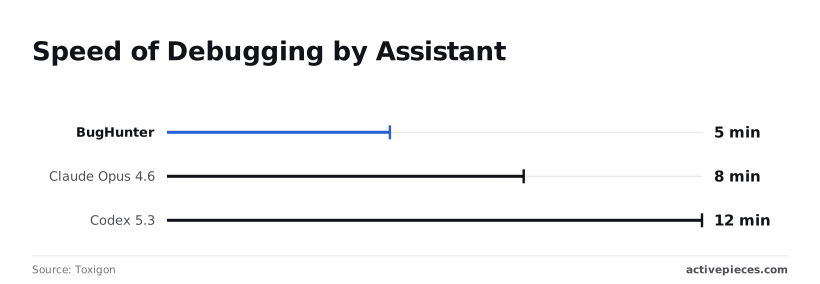
The following table summarizes the 2026 landscape for individual tiers, showing that while entry costs are low, the primary strengths vary significantly between raw reasoning and multimodal speed.
| Tool | Pricing (Individual) | Context Window | Primary Strength |
|---|---|---|---|
| Claude Opus 5.5 | $20/mo | 1.0M tokens | Long-horizon agentic coding |
| GPT-6 Astra | $20/mo | 400K tokens | Complex reasoning and logic |
| DeepSeek V4 Pro | $15/mo | 1.0M tokens | High-volume flagship throughput |
| Gemini 3.1 Pro | $4.99/mo | 1.0M tokens | Advanced reasoning and agents |
Prices and plan limits checked against docs.claude.com and claude.com and openai.com and gemini.google on September 26, 2026.
Price points directly dictate the reliability of the execution path. While a Google AI Plus subscription starts at $4.99 per month, OpenAI offers a "Go" tier with a 54K context window. That's exactly double the 27K window found in their Free tier.
Selecting the wrong tier for a 1.0M token task results in silent context clipping, where the AI hallucinations code based on the missing segments of the file.
The 2:14 AM failure: How an unverified AI suggestion broke production
Production outages occur when AI agents generate code that's syntactically correct but logically destructive to the specific environment they can't see.
The silent failure of the context window
Context clipping forces models to "guess" the remaining structure of a database. According to arXiv research, ChatGPT scores 91.52 on coding benchmarks.
Production outages occur when AI agents generate code that's syntactically correct but logically destructive to the specific environment they can't see.
It's the most likely to produce a working snippet but also the most likely to confidently hallucinate a non-existent parameter. In contrast, the performance of integrated tools drops sharply:
GitHub Copilot scores 7.50, so you must manually verify nearly every complex logic gate. CodeWhisperer scores 0.52, which means it functions primarily as a basic autocomplete rather than a reliable logic engine. Tabnine scores 0.46, which limits it to repetitive boilerplate tasks.
The financial cost of unverified AI code changes
A single unverified migration script can trigger a cascade that bypasses standard CI/CD checks if you grant the AI direct write access.
- At 2:14 AM, the AI suggested a "cleanup" script that lacked a
WHEREclause on a critical metadata table. - By 2:45 AM, the database hit a global lock, halting all customer transactions.
- A manual rollback attempt at 3:30 AM failed due to corrupted logs, and full restoration wasn't achieved until 5:00 AM.

The resulting $14,000 loss represents the direct cost of four senior engineers' emergency overtime and the SLA credits issued to 200 enterprise clients.
The limits of human review for AI code
Human review is currently the only safeguard against these failures. Yet it scales poorly against the speed of AI generation.
Safety requires moving past this manual bottleneck by embedding the AI into a deterministic execution path. This path simulates every suggested change against a twin of the production environment before writing a single byte.
Human review is currently the only safeguard against these failures. Yet it scales poorly against the speed of AI generation.
Activepieces provides the unified engine for this simulation, allowing teams to run an Agent step alongside deterministic automation steps in a single execution path.
The resulting run trace logs the entire sequence from start to finish, avoiding the fragmentation of bridging two separate systems with a callback webhook.
You can follow the rest of this with the builder open. Start free, no card.
Why AI coding tools fail on legacy system logic
AI coding tools fail on legacy logic because they prioritize syntactic patterns over the execution-time constraints of the underlying hardware and middleware.
The limitation of local file context
LLMs operate within a finite context window that ignores the environmental variables and external state required for successful deployment.
Even a high-capacity model like Gemini 3.8 Flash, which excels at parsing large codebases, can't "see" the specific firewall rules or load balancer timeouts.
The AI treats a legacy SQL schema as a clean slate. It's unaware that a specific column index was removed years ago to save storage, leading to a full table scan that freezes the application.
AI coding failures in microservices architectures
Modern AI agents struggle with distributed systems where the logic for a single transaction is spread across multiple isolated services.
The AI suggests a library feature available in the latest documentation, but your production environment is pinned to an older version for stability. An optimized loop runs too fast for a legacy API gateway, triggering automated IP bans.
Automating safety with Activepieces and LLM evaluation
Activepieces runs an Agent step alongside deterministic automation steps in one flow, a hallmark of the best AI agent builders, ensuring AI agents pass through predefined logic gates before touching production code.
Building an automated pull request review pipeline
A robust deployment pipeline uses Activepieces to intercept code changes and subject them to a multi-stage verification process that no single model can bypass.
This setup creates a physical separation between the generative process and the write-action. It ensures that a model like GPT-6.1 Sol can't unilaterally push a refactor without satisfying specific unit test requirements and security scans.
This visual sequence is the blueprint for an automated review gate where the "Human Input" trigger acts as the final authority. By requiring a manual signal to proceed, the system ensures that even the most sophisticated agentic workflows remain tethered to human oversight.
Connecting private documentation to your code editor
Integrating the Cursor code editor with Activepieces allows you to feed real-time infrastructure logs and private documentation directly into the IDE.
Every agent tool call and the data it acted on is captured in a trace that sits right next to the deterministic flow steps in the same run. In the Activepieces Run Details UI, these agent decisions are recorded in the same execution path as fixed logic, allowing for a complete audit of how internal data influenced a code suggestion.
The Google Drive integration pulls the latest internal SDK manuals to ensure the model isn't using deprecated syntax. The Text AI step uses Gemini 3.8 Flash to summarize technical debt logs so you see warnings alongside new code.
The Monday morning checklist for AI-assisted development
Securing an AI-augmented pipeline requires shifting from passive observation to active infrastructure constraints. By treating the Large Language Model (LLM) as an unprivileged user within the version control system, you prevent hallucinated dependencies from entering the main codebase.
Enforcing the 'three-file context' rule
Limiting the scope of a single AI prompt to three specific files prevents the model from losing focus on critical logic. When an agent like Gemini 3.8 Flash attempts to parse an entire monolithic repository, the "lost in the middle" phenomenon occurs.
The model ignores the middle 40% of the provided code and introduces regressions in business logic. Restricting the context window to the immediate task forces you to verify that the AI understands the local impact of its changes.
Requiring manual review for database migrations
Database schema changes must be excluded from automated "apply" permissions to ensure a human reviews the underlying SQL for destructive operations. AI agents frequently suggest DROP COLUMN commands to resolve naming conflicts, which results in permanent data loss.
You must require a manual signature on every migration file generated by tools like Claude Opus 5.5. This ensures that no automated script can modify the persistence layer without a verified rollback plan.
Setting token-spend alerts at the project level
Hard limits on API usage at the project level protect your infrastructure budget from runaway recursive loops. If an agent enters a "hallucination loop" where it repeatedly attempts to fix its own errors, it can consume the entire monthly credit limit in minutes.
Implementing these alerts ensures that a malfunctioning script triggers a kill-switch rather than a surprise invoice.
The following checklist is a baseline for hardening these workflows against the specific risks of autonomous code generation:
- Set branch protection rules to require status checks.
- Enable automated LLM-based linting.
- Tag all AI-generated code with metadata.
- Conduct peer reviews on all suggested refactors.
This protocol establishes a clear audit trail for every line of code, regardless of whether it originated from a human or a machine.
Frequently asked questions about AI coding tools?
Enterprise-grade deployment requires moving beyond the marketing gloss to understand exactly where your source code travels and how much of it the model can "see" at once.
Does GitHub Copilot train on my private code?
GitHub Copilot is the AI pair programmer integrated into the Visual Studio Code editor. It doesn't use snippets from private repositories to train its underlying models if you're on a Business or Enterprise plan.
This policy ensures that your proprietary logic remains within your organization's perimeter rather than leaking into the public suggestion pool.
Which AI for coding has the largest context window?
Gemini 3.1 Pro, the advanced reasoning model from Google, has a context window of 1.0M tokens. This massive capacity allows you to feed an entire microservices architecture or a multi-year legacy codebase into a single prompt.
The agent understands cross-file dependencies that smaller models would truncate. Without this breadth, an AI often suggests changes that break upstream functions it simply can't remember.
Can I run a coding AI entirely offline?
You can achieve complete network isolation by hosting open-weight models like Mistral Large 3 on internal hardware using an inference server such as vLLM. Running locally prevents any data from leaving your physical premises.
This is a hard requirement for defense contractors or high-compliance financial institutions. This approach demands significant local VRAM, but it eliminates the risk of a third-party API outage halting your development pipeline.
Related reading
References
Build it
Set this up in minutes.
No code required. Connect your accounts, and Activepieces runs it from there.
Start free Talk to sales