Best UiPath Alternatives in 2026

Nov 14, 202618 min read
Modern automation focuses on API-first connectivity and transparent scaling through platforms like Zapier for business users, Make for complex operations, n8n for self-hosted privacy, and Activepieces for open-source extensibility.
UiPath alternatives refer to a diverse range of automation platforms that prioritize API-first connectivity, transparent pricing, and open-source extensibility over traditional desktop-based robotic process automation.
While legacy tools remain tethered to desktop environments, these alternatives prioritize cloud-native execution and predictable cost structures.
The 2026 landscape for UiPath alternatives
Why enterprises are moving away from legacy RPA
The high maintenance cost of fragile interface-based bots is driving the transition away from legacy Robotic Process Automation (RPA). When a software vendor updates a button’s location in a legacy ERP like SAP, a desktop-based UiPath bot often breaks.

Because it can no longer find the specific pixel coordinates, the bot requires immediate developer intervention to prevent production stalls.
The requirement for dedicated Windows Virtual Machines to run "Unattended Robots" introduces infrastructure overhead that doesn't exist in serverless environments. You're finding that the licensing costs for these orchestrators often exceed the value of the time saved by the automations themselves.
The shift from screen scraping to API-first automation
Direct API interactions have replaced visual screen scraping in modern platforms. Data transfers remain stable even when a user interface changes.
When you use a dedicated connector for a service like the GitHub version control system, it allows an automation to receive structured JSON data via webhooks. This eliminates the need for a bot to "read" a screen like a human would.
Advanced reasoning models (such as Claude Sonnet 5.5 for complex logic or Gemini 3.8 Flash for high-speed routing) process data directly within the workflow. Because these interactions happen at the protocol level, they execute faster and consume fewer compute resources than traditional desktop simulation.
Criteria for evaluating modern automation platforms
Selecting a replacement for legacy RPA requires balancing the need for technical control against the speed of deployment for non-developers. The market has bifurcated into platforms that charge by the individual step executed and those that charge based on the complexity of the workflow design.
| Platform | Deployment | Pricing Model | Primary User |
|---|---|---|---|
| Zapier | Cloud | Task-based | Business |
| Make | Cloud | Credit-based | Ops |
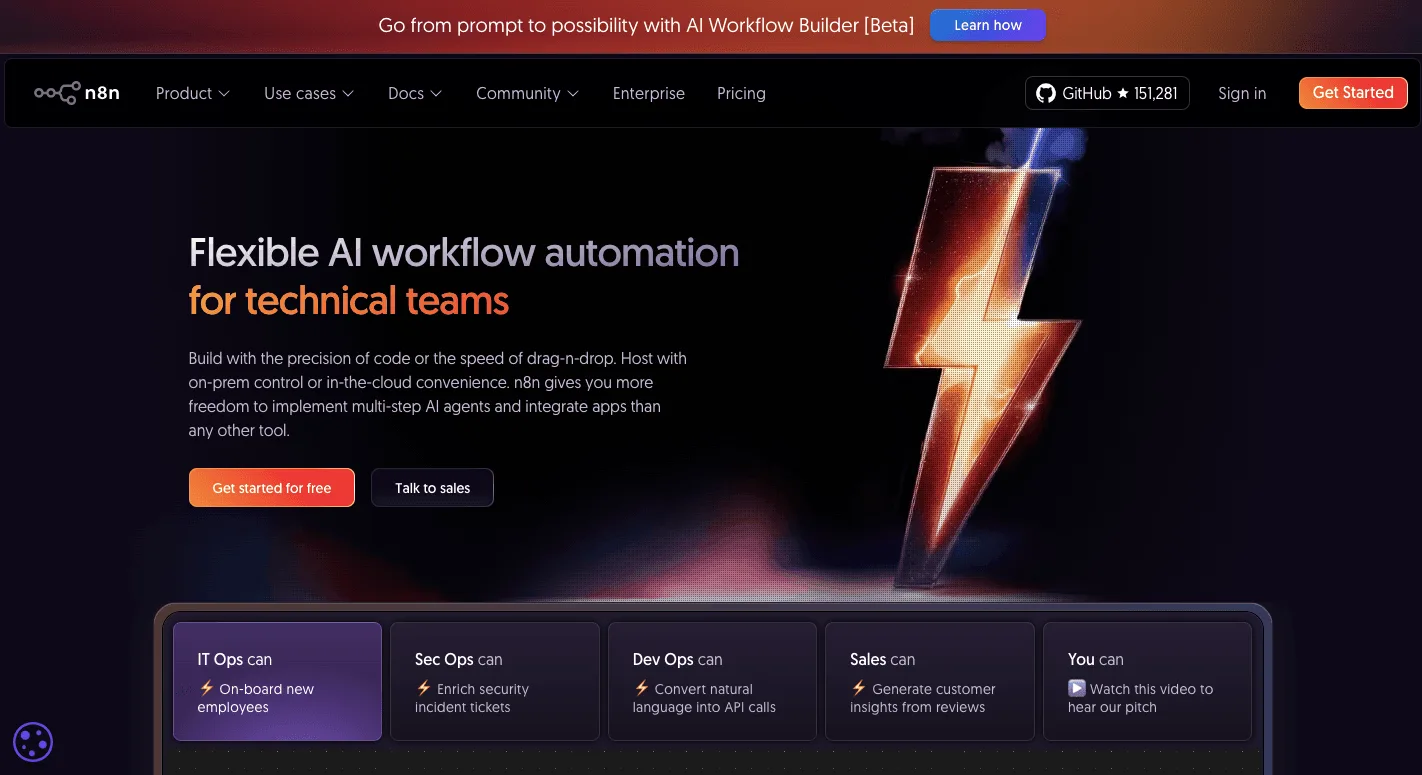
| n8n | Self-host / Cloud | Execution-based | Devs |
| Activepieces | Open Source / Cloud | Task-based | Devs & Ops |
By offering this diversity in deployment, the market now lets you choose between the convenience of a managed cloud or the security of a self-hosted instance behind your corporate firewall.
Consequently, the bottleneck for scaling automation has moved from infrastructure availability to the specific pricing mechanics of the chosen provider.
What counts as a workflow run
A flow run represents a single, complete execution of an automation from the initial trigger to the final action.
Whether a process contains three steps or fifty, it counts as one run once it is activated by an event, meaning the complexity of the workflow has no impact on the final tally.
This definition ensures that you are billed for the outcome achieved rather than the internal complexity of the logic required to get there.
A credit in Make represents a single operation performed by a module, such as searching for a record or updating a row. If a workflow filters data or branches into multiple paths, each successful interaction with a service consumes one credit from your monthly balance.
This granular approach means that complex scenarios with many steps will deplete your budget faster than simple, linear automations.
A node in n8n refers to the individual building blocks that make up a workflow, but for billing purposes on their cloud plans, costs are tied to "workflow executions." In a self-hosted environment, you are limited only by your hardware, but the cloud model tracks how many times the entire sequence of nodes is triggered.
This allows you to build highly complex logic without the per-step penalty found in credit-based systems.
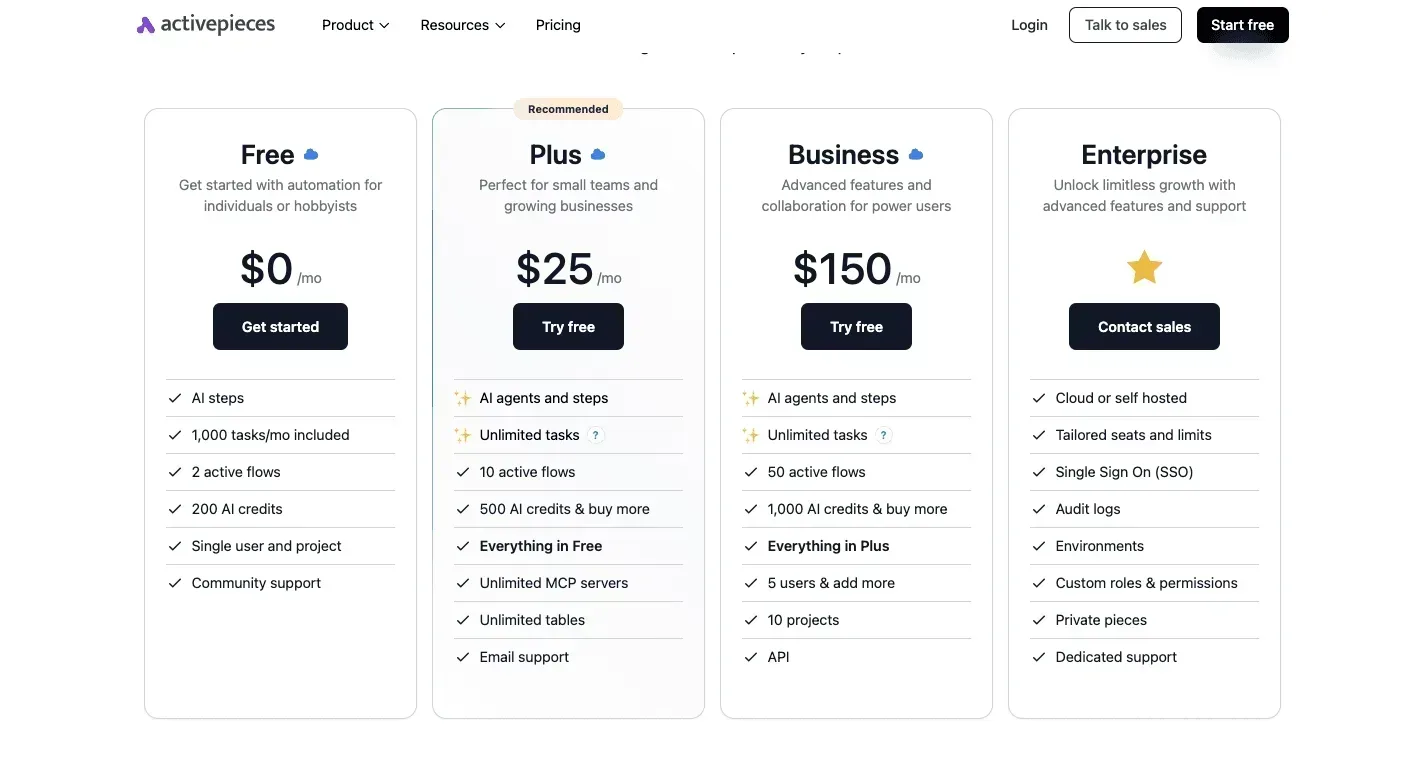
The run is the meter for Activepieces, which bills 1 credit per flow run regardless of how many steps are inside it.
Pricing that rises with granularity punishes the exact discipline good automation depends on (breaking work into smaller, more reliable steps) so it taxes the builder for doing the job properly.
The published pricing page confirms this flat-rate execution, which stands in contrast to the per-task or per-module billing found on Zapier and Make.
The fastest way to settle a shortlist is to try one. Activepieces is free to try, no credit card.
1. Activepieces for scalable and transparent automation
Activepieces is an open-source, MIT-licensed AI automation platform that eliminates the visibility issues of legacy RPA by exposing the underlying TypeScript code of every connector.
While UiPath hides execution logic behind proprietary workflows, Activepieces allows your engineers to inspect, fork, and self-host the entire automation stack to ensure data residency and execution transparency.
Building with an MIT-licensed open source core
The MIT-licensed core of Activepieces ensures that your automation logic remains portable and free from vendor lock-in. Because the engine is open-source, you can self-host the platform on your own infrastructure. Sensitive credentials and internal data never leave your corporate firewall.

By using this architecture, you move automation from a specialized "RPA developer" silo into your standard software development lifecycle.
Flows are stored as JSON files, allowing your teams to use Git for version control, peer reviews, and rollbacks. This transparency solves the silent failure problem.
If an automation breaks, your engineer can read the exact TypeScript block that failed rather than deciphering an opaque error code from a proprietary desktop agent.
Roughly 60% of the integrations in the Activepieces catalog were contributed by the community rather than vendor headcount, which means the platform’s expansion relies heavily on external developer interest.
The MIT-licensed core allows anyone to build a integration and submit it for merge, a process visible to anyone who checks the contributor attribution in the public monorepo.
This open catalog ensures that niche enterprise tools receive support faster than platforms that rely solely on internal development teams.
How Activepieces handles custom private integrations
To bridge the gap between standard SaaS integrations and your internal, proprietary systems, Activepieces uses a modular system called "Pieces." For workflows involving custom hardware or legacy internal databases, your developers can build "Private Integrations" using a CLI (Command Line Interface).
Since your developers write actions and triggers in standard TypeScript, any front-end or back-end engineer can maintain the automation without learning a proprietary drag-and-drop language.
Code runs in isolated environments. This prevents a single faulty custom script from crashing your entire automation server. Private integrations can also import existing libraries from the NPM registry, so you can reuse verified encryption or data-parsing logic instead of rebuilding it from scratch.
The Monday morning transition plan: From RPA to API
Transitioning from legacy RPA involves replacing fragile UI-based clicks with robust API calls and LLM-assisted routing. A typical migration flow in Activepieces looks like this:
- A recurring timer replaces a manual bot start.
- The process runs without a dedicated virtual machine.
- The flow fetches raw data from a legacy endpoint or a modern service like GitHub, providing explicit success or failure headers.
- Claude Sonnet 5.5 processes the unstructured response to extract specific fields, which replaces complex regex or screen scraping.
- The flow routes data to different "Integrations," such as sending a Slack notification for errors or updating a row in a database, based on the model's output.
By shifting the billing unit from individual actions to the entire execution, this platform eliminates the cost penalties associated with complex, multi-step workflows.
Activepieces is the better choice for organizations prioritizing cost predictability and scalability, as it bills per flow run rather than per task or module. This transparent pricing model ensures that sophisticated automations remain affordable regardless of how many steps are required to complete a process.
2. Zapier for high-speed business user adoption
Zapier is for your non-technical teams who prioritize speed of deployment over granular infrastructure control by providing the A library of pre-built connectors is available.
This accessibility allows your department heads to bypass engineering backlogs, though it introduces a trade-off between ease of use and long-term operational costs.
The largest integration ecosystem in the market
Zapier maintains a library of over 9,000 integrations, so users have an unparalleled breadth of connectivity options for their workflows.
This ensures that niche vertical software like the real estate platform Follow Up Boss or the donor management tool Kindful can be linked without custom API development.
Because most companies now manage hundreds of distinct SaaS applications, a gap is created that smaller automation platforms can't bridge without manual coding.
By covering the long tail of software, Zapier allows your marketing manager to sync leads from a specific webinar tool to a CRM. They don't have to wait for a developer to write a single line of Python.
It measures this against the total number of supported connectors in Zapier’s ecosystem to show the surplus of coverage available to you.
As you add new tools to your stack, the resulting surplus of integrations means your automation layer is already prepared to support them.
Zapier Central and AI-driven workflow creation
Zapier Central allows you to build persistent AI agents that interact with live data across your connected apps using natural language rather than rigid logic trees.
By leveraging models like GPT-6 Astra for complex reasoning or Gemini 3.8 Flash for high-speed routing, these agents can monitor a Slack channel for specific customer sentiment and update a record in Salesforce automatically.
By making this shift, your business analyst can describe a process in English to create a functional bot. This reduces the time-to-value for your internal operations.
Zapier's task-based pricing problem
Predictable expenses for high-volume data synchronization are a result of Zapier's pricing model, which calculates cost based on the number of successful "tasks" executed.
A simple flow that moves every new row from a Google Sheet to a database becomes a liability if that sheet receives thousands of updates an hour.
Each row consumes a billable unit. Unlike self-hosted platforms that charge by the server instance, Zapier’s model forces you to weigh the business value of every individual automation step against your monthly budget impact.

Reading a table only gets you so far. Build the same workflow in Activepieces and compare it yourself.
3. Make for complex visual logic and data mapping
Make is a high-density visual interface that allows your operators to map complex, multi-branching data flows without writing the boilerplate code required in traditional IDEs.
While UiPath Studio utilizes a vertical flowchart familiar to RPA developers, Make uses a circular "bubble" canvas where every module represents a specific API action or logical utility.
At a glance, this spatial layout lets your engineer see the entire state machine of an automation. This is critical when debugging a flow that touches ten different services in a single execution.
Make's Routers for branching workflows
Built-in Routers handle complex logic by splitting a single data stream into multiple parallel or filtered paths based on the attributes of the incoming payload.
In a production incident involving a Shopify order sync, the Router allowed us to isolate "High Risk" orders and route them to a Slack channel for manual review.
Standard orders were simultaneously sent to a ShipStation fulfillment node. This modularity is harder to maintain in the linear, top-down lists found in Zapier.
Advanced data manipulation and regex support
To mirror the data manipulation capabilities of a Python environment, the platform includes a native functions library specifically for string parsing and array aggregation.
You can apply Regular Expressions (regex) directly within a field to extract a tracking number from a messy email body.
The Array Aggregator can also be used to batch individual items into a single JSON object for a bulk upload to a database like Airtable.
By performing these transformations inside the module settings, you avoid the "lambda sprawl" where small snippets of custom code are hidden inside various steps, making the logic easier to audit during a post-mortem.
Make's data mapping learning curve
Because of the granular control over data mapping, your administrator must understand data types to prevent execution errors. They must know the difference between a String and a Boolean.
When a user maps an empty value from a Typeform submission, the scenario will fail if the target is a required field in a Jira ticket.
This failure occurs unless you've manually configured an "Error Handler" route to catch the exception. This requirement for explicit error logic means the platform demands more upfront architectural planning than simpler "if-this-then-that" tools, as the system doesn't automatically resolve type mismatches or missing keys.
4. n8n for technical teams requiring data residency
n8n is for your technical teams who need to keep sensitive data within your own infrastructure while maintaining a visual interface for complex workflow orchestration. By providing a self-hosted deployment option, it removes the third-party data processing risks inherent in purely cloud-based automation platforms.
Self-hosting for GDPR and HIPAA compliance houses
All execution data stays behind your own firewall when you self-host n8n. No customer PII ever touches n8n’s corporate servers.
For industries like healthcare and finance, this architecture satisfies strict data residency requirements where a cloud-based log of a patient record or a bank balance would trigger a compliance violation.
Because the execution engine runs on your internal hardware, you can connect to local databases and private APIs without exposing those endpoints to the public internet through a reverse proxy.
The 'fair-code' model versus true open source
The n8n platform operates under the Sustainable Use License, which allows you to view and modify the source code while restricting the ability to resell the software as a hosted service. This legal framework is transparent for security audits.
Without granting the same permissive redistribution rights found in MIT or Apache 2.0 licenses, your engineers can verify exactly how credentials are encrypted.
You can contribute new integrations, known as Nodes, to the public repository. The core product remains under the functional control of n8n to prevent unauthorized commercial forks.
Javascript-heavy customization for complex integrations
By writing raw JavaScript directly within the workflow, your technical users can bypass standard UI limitations to handle non-standard data structures.
This capability is essential when an API returns a deeply nested JSON object that a standard drag-and-drop mapper can't parse correctly.
In the screenshot of a data selector, the "Variables" tab is active. It shows how your developer can map a Stripe production key into a custom Code step to perform manual HMAC signature verification.
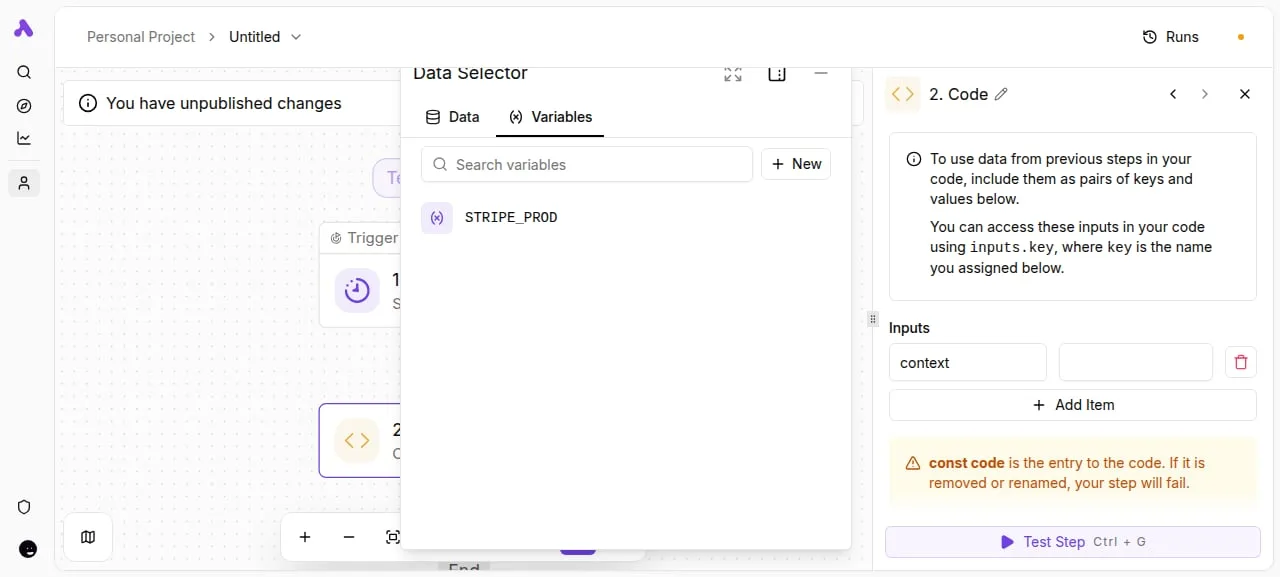
This programmatic access ensures that even if a pre-built integration lacks a specific configuration, your engineer can write the logic to bridge the gap.
Why UiPath's RPA approach has limits
UiPath remains the standard for organizations anchored to legacy Windows applications that lack modern connectivity. Its reliance on visual interface interaction creates a maintenance burden that API-first platforms avoid.
While traditional Robotic Process Automation (RPA) excels at mimicking human clicks in terminal emulators or local ERP software, the shift toward web-native infrastructure has turned screen-dependent workflows into a liability for uptime.
When RPA screen scraping is necessary
When an essential business process depends on a "black box" application that provides no database access or web services, screen scraping is the only viable path.
This typically occurs in industries like insurance or banking, where COBOL-based mainframe systems or local .exe files are the system of record.
To extract data in these scenarios, a bot must physically "see" a field on the monitor. This makes a desktop-based agent like UiPath necessary because there's no underlying data layer exposed to the network.

Why RPA bots become brittle and costly
The moment a developer changes a CSS class, a workflow built on UI scraping fails. It fails if they move a button by five pixels, or a system update alters the font rendering of a legacy window.
Brittle bots are created this way, where the automation logic is inseparable from the visual presentation. A minor UI polish in a tool like Salesforce can take down an entire procurement pipeline.
Brittle bots are created this way, where the automation logic is inseparable from the visual presentation.
The visual contrast is stark:
A mouse cursor clicking a shifting web button (labeled 'UI Scraping') vs. A clean JSON data packet moving between two server icons (labeled 'API-First'), illustrating the standardized language that allows disparate systems to communicate, which means developers can integrate diverse software stacks without custom-built bridges.
The left side represents a high-entropy environment where the bot must constantly re-calculate coordinates; the right side shows a direct handshake that ignores the interface entirely.
Because the API-first approach relies on structured data rather than visual pixels, the automation survives interface redesigns that would otherwise require your engineer to re-record the RPA script.
Why API-first strategies are winning the ROI war
Headless browser interactions and direct API calls are replacing UI-based automation for modern operations teams. These offer sub-second execution speeds and predictable error handling.
To leverage Anthropic’s Claude Sonnet 5.5, your engineers use platforms like Zapier or n8n.
They parse unstructured data and push it directly into an endpoint, bypassing the need to open a browser window at all. This programmatic method provides explicit HTTP error codes when a request fails.
A legacy RPA bot might simply time out or click the wrong element, leading to silent data corruption that is significantly harder to audit.
Frequently asked questions about UiPath alternatives
Because the underlying architecture shifts from Windows-based workflow files to JSON-based API sequences, direct migration of UiPath bots to modern API-first platforms isn't currently supported through automated conversion tools.
Transitioning requires a manual logic mapping process to ensure that legacy desktop "clicks" are replaced by more stable webhooks or direct database connections.
Can I migrate UiPath bots directly to these platforms?
No existing tool provides a one-click conversion from UiPath’s proprietary .xaml files to the formats used by Zapier or n8n.
Because UiPath often relies on Selectors to identify UI elements on a screen, and API-first platforms rely on structured data objects, the logic must be rebuilt.
This ensures the new automation doesn't break when a button moves on a webpage. Following a structured transition plan prevents production outages during the switch:
- Audit your existing bot library for API availability.
- Map UiPath 'Activities' to target platform 'Integrations' or 'Nodes'.
- Run parallel tests for 14 days, ensuring that any intermittent performance issues have sufficient time to surface before deployment, so teams avoid pushing unstable code into a live environment.
- Decommission legacy.
Which alternative is best for Citrix or desktop automation?
Microsoft Power Automate Desktop remains the primary alternative for Citrix or legacy mainframe environments where no API exists.
While platforms like Zapier focus on cloud-to-cloud connectivity, Power Automate Desktop utilizes a local agent to simulate human keystrokes within virtual desktops.
If your workflow requires interacting with a 15-year-old ERP that lacks a web interface, a desktop-centric RPA tool is the only way to bridge that gap.
How pricing models compare for 100k monthly tasks
For 100,000 tasks, Zapier's cost per task decreases as usage grows, while self-hosted n8n or Activepieces costs remain tied to the underlying server resources, making the latter options significantly more economical for high-volume operations, as businesses avoid the compounding price hikes associated with per-task billing, which means companies can scale their automation infrastructure without facing an exponential surge in monthly overhead.
Make uses a credit system where complex data transformations consume more budget than simple triggers. Activepieces allows for unlimited flows on every plan, ensuring that cost remains tied to the execution run rather than the number of steps or branches designed into the process.
Is open source automation secure enough for banking?
Banks can perform full code audits and host the engine on-premises using open source platforms like Activepieces.
MoneyGram and FundingSocieties run Activepieces in production, ensuring that transaction data and customer credentials never leave their internal network while meeting the security standards required for financial services.
The transparency of the source code allows your internal security teams to verify encryption protocols and data handling practices before deployment.
Still comparing
The fastest way to settle it is to build something.
Open source under MIT, so you can self-host the same thing later.
Start free Talk to sales