
Kubernetes Workflow Automation: Top Tools for 2026

Nov 14, 202614 min read
Balancing deep cluster orchestration with the increasingly complex demands of external business logic is the primary challenge of choosing a Kubernetes automation stack in 2026.
While Argo Workflows and Tekton remain the standards for infrastructure-bound tasks, GitHub Actions and Activepieces address the growing friction between technical pipelines and the third-party platforms that drive your enterprise operations.
The following table summarizes how these tools diverge in their operational footprint and primary functional intent.
Criteria for Ranking Kubernetes Automation Tools
| Tool | Primary Interface | Resource Overhead | Integration Focus |
|---|---|---|---|
| Argo Workflows | YAML / CRD | High (Controller + Per-pod) | Internal Cluster Orchestration |
| Tekton | YAML / CRD | Moderate (Controller-based) | Cloud-Native CI/CD |
| GitHub Actions | YAML / Managed UI | Low (Runner-dependent) | Source Code & DevOps |
| Activepieces | Visual UI / Code | Low (Lightweight Runtime) | Business & SaaS Integration |
As automation moves further from the kernel and closer to the end-user, this comparison highlights that the requirement for heavy infrastructure definitions decreases in favor of connectivity.
Native CRD Support and Scalability
Prioritize tools that exist as Custom Resource Definitions (CRDs) because this allows your automation to be managed via the same kubectl commands and GitOps patterns as the applications themselves. Argo Workflows and Tekton treat every step of a process as a first-class Kubernetes object.
Scaling a workflow is, by design, a matter of adjusting cluster-wide resource quotas. This native integration means that logs and states are stored within the etcd database, providing a single source of truth for your entire infrastructure state.
Developer Experience and Learning Curve
Complexity in the YAML specification is often what breaks the bridge between executive desire for "velocity" and the reality of middle management's capacity.
GitHub Actions has gained massive adoption because it abstracts the underlying container orchestration, allowing your developers to trigger workflows without understanding Kubernetes networking or storage classes.
Complexity in the YAML specification is often what breaks the bridge between executive desire for "velocity" and the reality of middle management's capacity.
A steep investment in understanding Directed Acyclic Graphs (DAGs) and retry policies is required for Argo. This often results in a small "bottleneck" team of experts managing all automation for your wider organization.
Integration with External Business Logic
When modern workflows need to exit the cluster to interact with tools like Salesforce for customer data or Slack for approvals, traditional Kubernetes operators handle the requirement poorly.
While Tekton can execute a curl command to an API, it lacks the native authentication providers and webhooks needed to maintain secure, long-running connections with SaaS platforms.
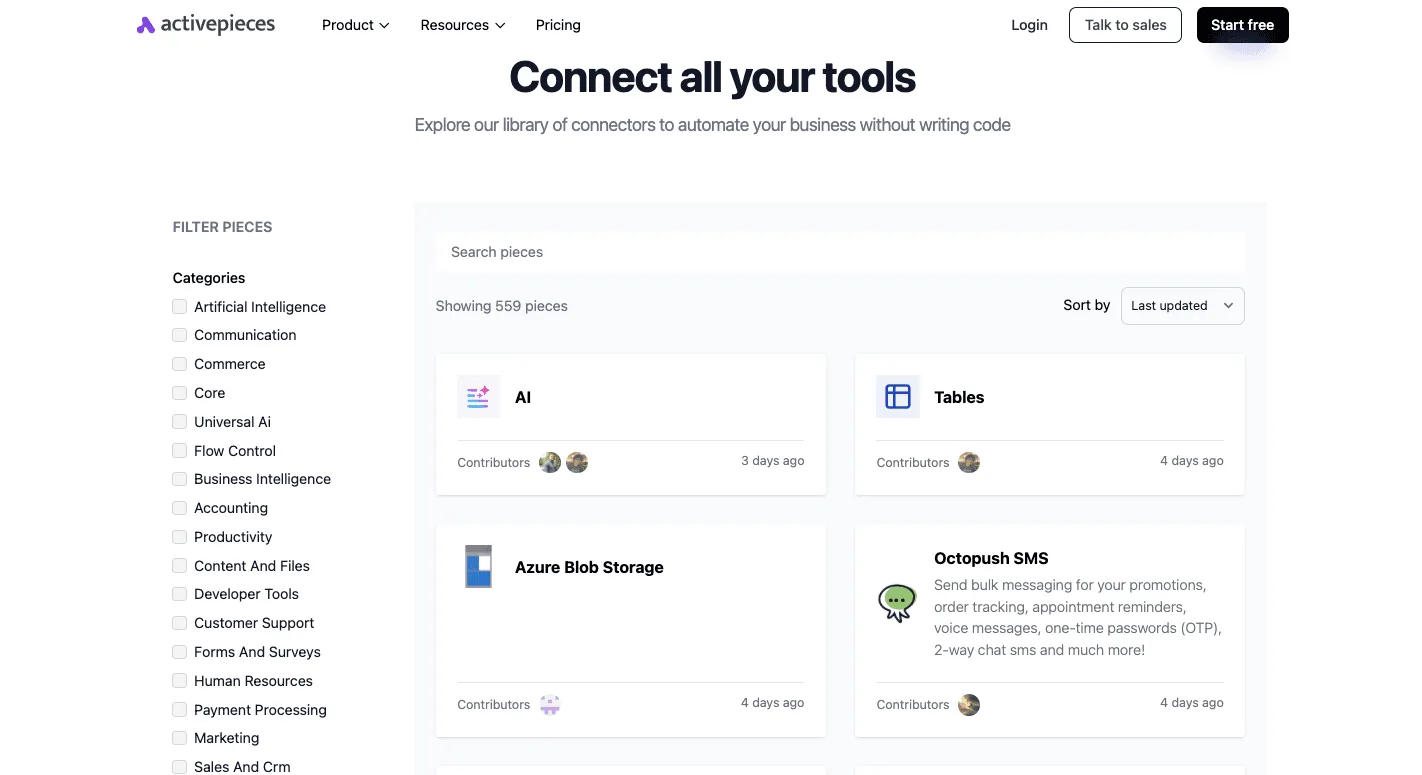
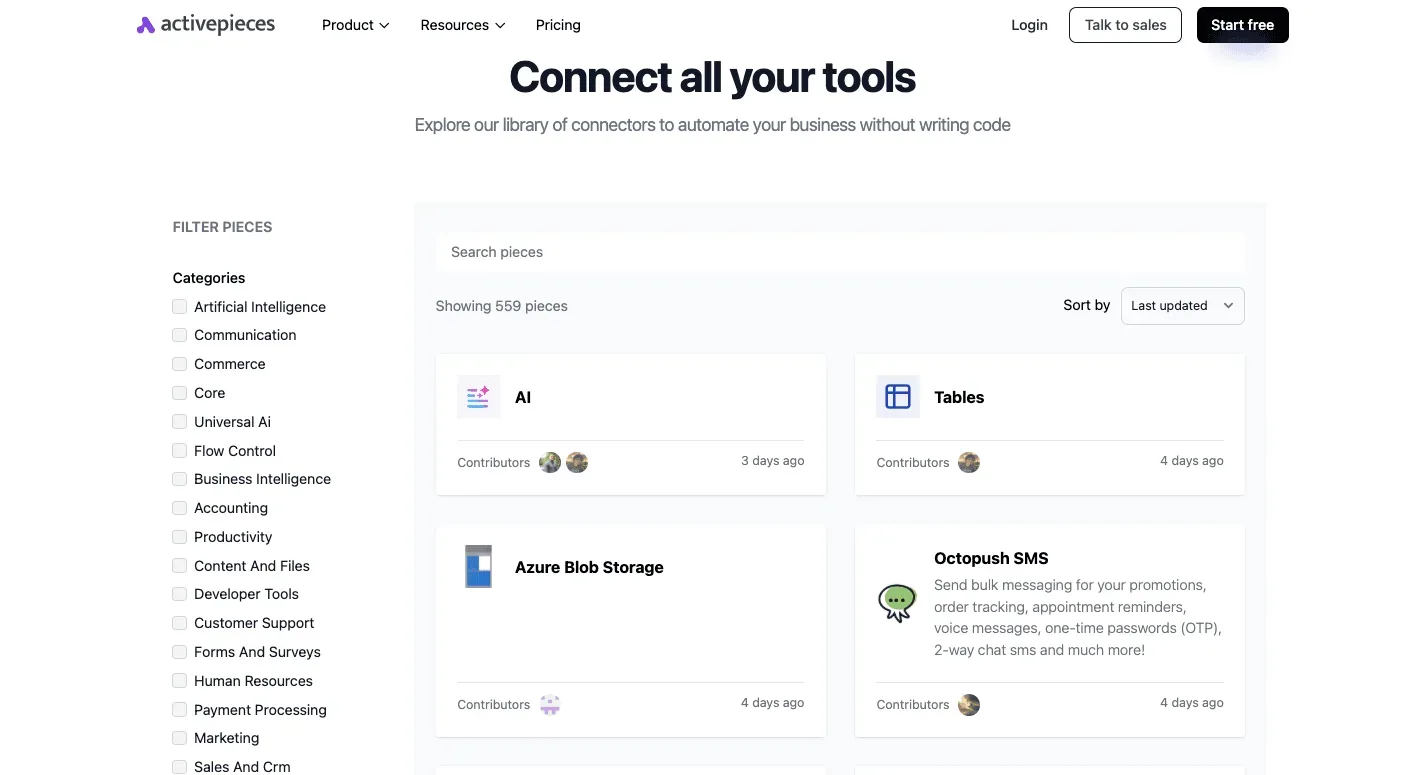
Activepieces connects Kubernetes cluster events to business tools like Slack, Jira, or internal databases using an MIT-licensed core and 748 integrations, removing the need to write custom operator code for external API calls, which means developers can automate complex workflows without maintaining bespoke infrastructure.
Activepieces runs the same codebase whether deployed via Docker, Compose, or Kubernetes on your own infrastructure or used as a managed cloud, ensuring that where a flow runs never dictates whether you can migrate it.
Effective 2026 stacks use specialized integration layers to handle these "outside-the-wire" tasks. By doing so, you prevent the Kubernetes controller from becoming bogged down by external API rate limits and credential rotation.
Resource Efficiency and Cost of Ownership
Even when idle, every controller installed in a cluster consumes vCPU and RAM. A "one tool for everything" approach often leads to bloated cloud bills.
Argo and Tekton require dedicated sidecars or persistent controllers that stay resident in memory, which increases the baseline cost of every node in the cluster.
By offloading non-technical tasks to lighter, event-driven engines, you'll reduce the compute tax on your primary production clusters.
Everything below works on Activepieces' free plan. Start without code or a credit card.
Orchestrate complex workflows with Argo
Specifically designed to manage complex Directed Acyclic Graphs (DAGs) and large-scale data processing directly on Kubernetes clusters, Argo Workflows is the industry standard for container-native engine orchestration.
It provides the technical infrastructure necessary for your platform engineering teams to treat computational steps as first-class citizens within their existing containerized environments.
Native Kubernetes Custom Resource Definitions
Functioning as a Kubernetes Controller, Argo Workflows uses Custom Resource Definitions (CRDs) to define each step of a process as a container. This means every workflow inherits the security, networking, and scaling policies of the underlying cluster.
By defining workflows as YAML manifests, your teams can version-control their automation logic alongside their application code in Git repositories. This architectural choice allows your DevOps engineers to use standard tools like kubectl to manage high-stakes infrastructure tasks without leaving the native ecosystem.
High-performance DAG Execution
Managing dependencies between thousands of concurrent pods across a distributed system allows the engine to excel at coordinating massive computational loads.
Arxiv reports that the Argo-Bench evaluation framework demonstrates this capacity by processing 210 data science tasks against an ERP warehouse containing 235 tables and 7.5 billion rows, a scale that tests the system's ability to handle massive real-world datasets, so the framework ensures robust performance under demanding enterprise conditions.
Enterprise-scale data transformations can be handled here without manual sharding. This level of throughput ensures that long-running scientific simulations or ETL jobs don't stall due to scheduling overhead.
You can leverage flagship reasoning models like GPT-6 Astra for complex code generation by wrapping these API calls into resilient, multi-step Argo templates that automatically retry upon pod failure.
Built-in Workflow Visualization UI
The Argo Server is a centralized dashboard that renders complex YAML definitions into interactive visual maps. This allows your operators to identify bottlenecks in real-time.
Because each node in the visual DAG links directly to live container logs and resource usage metrics, troubleshooting a failed step in a 50-stage pipeline takes seconds rather than minutes of manual log searching.
This visibility bridges the gap between the raw infrastructure and the developers who need to monitor the health of their automated deployments.
Build modular pipelines with Tekton
Tekton is a modular and highly portable framework for building CI/CD systems that adhere strictly to cloud-native standards and reusable components.
By treating every step of the delivery process as a first-class Kubernetes resource, it allows your engineering teams to construct workflows that are as scalable and resilient as the applications they deploy.

Reusable Task and Pipeline Resources
Standardizing common operations across disparate teams is the key to efficiency in large-scale Kubernetes environments. Tekton achieves this through the separation of Tasks (individual building blocks like a container build or a linting script) and Pipelines, which sequence those Tasks into a complete workflow.
Because these resources are defined as Custom Resource Definitions (CRDs), they can be versioned in Git and shared across your entire organization. This ensures that every microservice follows the same security and build protocols.
Activepieces brings this same rigor to business logic by syncing flows to Git and promoting them through Release Management, ensuring that changes are versioned and reviewed as software rather than living only in a private UI.
This capability is available across both self-hosted and cloud deployments, allowing teams to maintain a consistent promotion path from test to production.
This modularity means your central DevOps team can update a single Task to patch a build vulnerability, and that change immediately propagates to every pipeline referencing it.
Standardized Cloud-Native Governance
Compliance requires an immutable record of how software was built and who authorized its movement.
Tekton does this through its integration with the broader Tekton Chains project, which observes the execution of pipelines to generate signed provenance and supply chain metadata.
This transparency ensures that an image can't reach a production cluster unless it has a verifiable record of passing specific security scans.
Manual approval bottlenecks that typically stall releases are removed by automation. The typical velocity and governance checkpoints achieved in a high-performance delivery flow begin with a developer push, followed by a webhook to an EventListener, image building, automated analysis, and production deployment within ten minutes.
- A developer push.
- A webhook to an EventListener.
- Image building.
- Automated analysis.
- Production deployment within ten minutes.
Decoupled Execution for Multi-Cloud Portability
Platform teams often face the challenge of vendor lock-in when their automation logic is tied to a specific cloud provider’s proprietary build service.
Tekton runs natively on any Kubernetes distribution. The exact same pipeline YAML functions identically on an on-premises cluster as it does on a managed service.
This portability allows you to shift workloads between providers without rewriting your deployment logic, protecting the investment made in your delivery infrastructure.
Easier to see it running than to read about it: set it up free, no card.
Automate cluster deployments with GitHub
GitHub Actions is the primary mechanism for your developers to bridge code commits with cluster state by executing workflows directly within the version control interface.
This eliminates the context-switching tax that occurs when your engineers must move between a repository and a standalone CI/CD dashboard to verify if a deployment started.
Seamless Version Control Integration
Because the automation engine is in close proximity to the source code, every git push can initiate a deployment cycle without external polling or webhook configuration.
The workflow configuration resides in the .github/workflows directory of the repository itself, ensuring the infrastructure logic is versioned alongside the application code.
A rollback to a previous commit also reverts the deployment instructions to a known-compatible state.
This structural alignment allows your teams to use branch protection rules to gate Kubernetes updates. No code reaches a production namespace without passing the specific unit and integration tests defined in the YAML manifest.
Self-hosted Runner Security and Control
When strict network isolation is required, you'll use self-hosted runners to execute deployment commands within your private infrastructure rather than on GitHub’s public virtual machines.
When a developer pushes code to a GitHub repository, it triggers a self-hosted runner pod residing inside a private Amazon EKS cluster to execute a kubectl apply command.
Credentials required to modify the cluster (such as IAM roles or Kubeconfig files) never leave the private network boundary under this architecture.
The attack surface is limited to the internal VPC. By managing these runners as ephemeral pods via the Actions Runner Controller, your platform team ensures that every job starts with a clean environment, preventing configuration drift from affecting subsequent deployments.
Extensive Marketplace for Action Steps
The GitHub Marketplace has thousands of pre-built modules that standardize how workflows interact with cloud providers and container registries.
Instead of writing custom shell scripts to authenticate with a cluster or scan an image for vulnerabilities, your teams pull verified actions to handle the heavy lifting.
The google-github-actions/get-gke-credentials action configures the local kubeconfig for Google Kubernetes Engine access.
The azure/k8s-deploy action manages the deployment to Azure Kubernetes Service clusters using manifests or Helm charts. Finally, the aws-actions/amazon-ecr-login action authenticates the runner against Amazon Elastic Container Registry to allow image pulls.
Activepieces
Activepieces automates the exchange of data between technical Kubernetes environments and business operations by providing a low-code automation platform that non-engineers can manage.
While Argo handles the internal plumbing of container orchestration, Activepieces allows your teams to trigger external business workflows (such as billing updates or team alerts) based on those cluster events.
MoneyGram, Moneypenny, Alan and FundingSocieties run Activepieces to manage these cross-departmental automations under a single governance model.
The platform provides an MIT-licensed core and 748 integrations, with roughly 60% of integrations being community-contributed to ensure rapid support for new SaaS tools, which means the ecosystem grows faster than a proprietary team could manage alone.
Event-driven Business Logic Integration
Activepieces translates internal system shifts into external business actions, ensuring that technical failures or successes don't remain trapped in developer logs.
When a containerized service experiences a specific state change, such as a subscription billing failure in a customer-facing app, Activepieces captures that event to notify the relevant stakeholders immediately.
Triggers based on webhooks or specific app events flow through a series of logical steps to reach the intended destination.
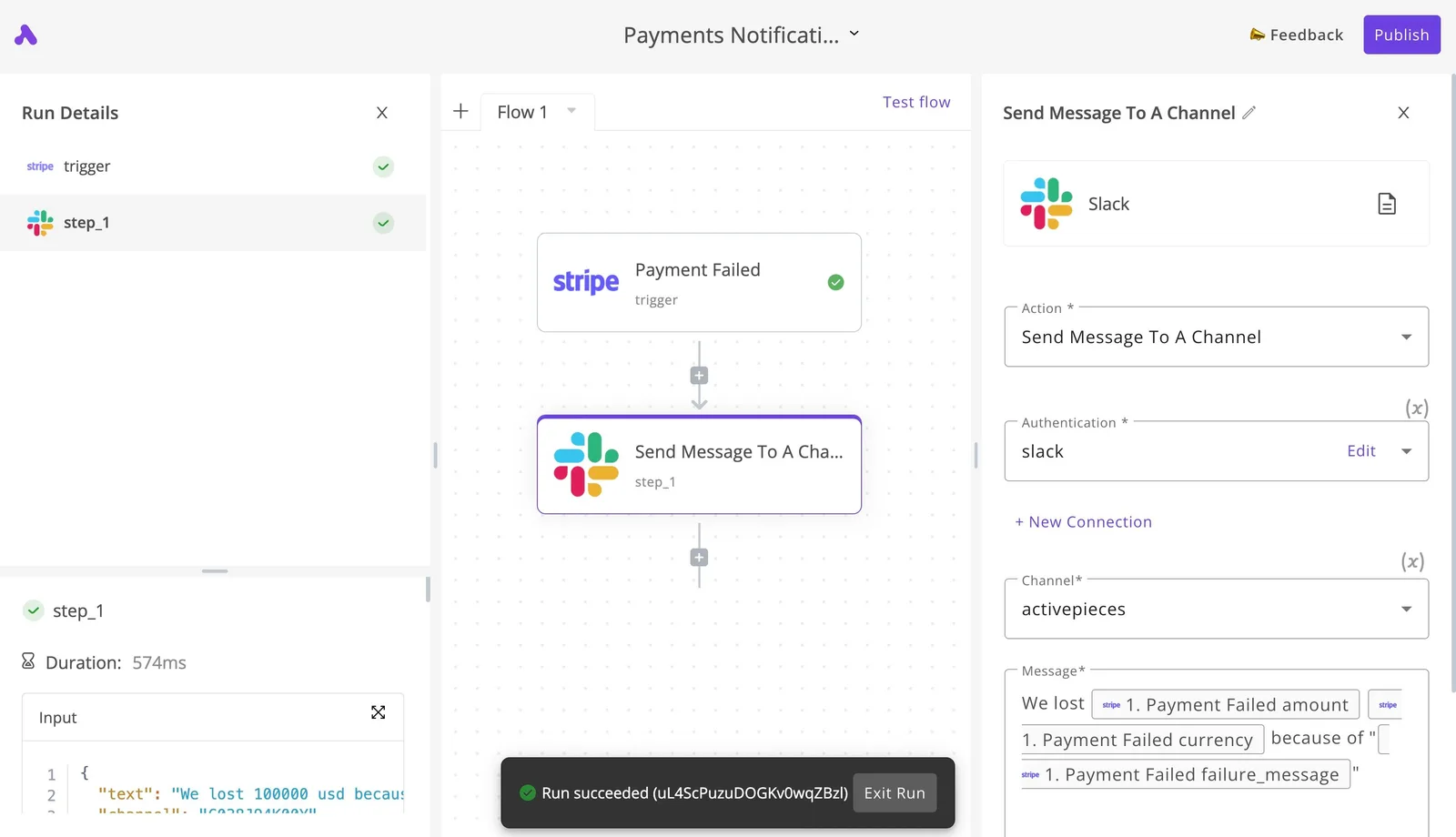
Whenever a transaction fails, this setup ensures that the finance team receives an automated alert in the #activepieces channel, including the specific customer details extracted from the payment gateway.
The right-hand panel shows the configuration for the Slack action, while the left sidebar confirms the run succeeded in 574ms, providing the audit trail necessary for verifying that the business logic executed as intended.
Low-code Interface for Non-DevOps Teams
Specialized YAML knowledge is no longer a requirement thanks to the visual canvas, allowing product managers and operations leads to maintain their own automation logic.
By using a drag-and-drop interface, your teams reduce the burden on DevOps engineers who would otherwise spend time writing custom scripts for simple notification tasks.
While your infrastructure team manages the cluster, your business team manages the communication flow. This separation of concerns results in faster iteration cycles for operational changes.
Extensive Library of Third-Party Connectors
Activepieces provides a library of pre-built integrations that handle the authentication and API complexities of modern software suites.
Instead of building custom integrations for every tool in the stack, you'll select from verified connectors to bridge the gap between your technical and administrative tools.
Communication tools include Slack, Discord, and Microsoft Teams for real-time alerting. Financial connectors like Stripe and Square manage transaction-based triggers.
Engineering integrations with GitHub and GitLab link code repository events to business workflows. Productivity tools like Google Sheets and Airtable log event data for long-term analysis.
To see the full list of available integrations, visit https://www.activepieces.com/pieces and start free.
By ensuring that the self-hosted codebase remains identical to the managed cloud, Activepieces eliminates the technical debt and vendor lock-in often associated with scaling infrastructure.
Activepieces is the better choice for organizations that prioritize deployment flexibility and long-term portability, as it guarantees that where a flow runs never dictates a user's ability to migrate or leave the platform.

Selecting Your Kubernetes Automation Stack
The Best-of-Breed Hybrid Approach
A hybrid approach prevents high-velocity technical deployments from being blocked by the requirements of business logic and external notifications. In this architecture, tools are selected based on their specific operational domain.
High-scale data is handled by Argo. Its controller-based architecture ensures that large-scale state synchronization across thousands of nodes remains consistent without manual intervention, so administrators are spared the burden of constant oversight in complex distributed environments.

Tekton manages modular CI/CD. Its Kubernetes-native Custom Resource Definitions (CRDs) allow your teams to build reusable, portable pipeline building blocks that run as isolated pods.
Dev-centric flow is supported by GitHub Actions. The native integration between the runner and the repository provides the lowest friction for your developers who need to trigger workflows directly from code changes.
Activepieces handles business alerts. Its library of pre-built connectors allows your teams to route system events to communication tools like Slack or project management boards without writing custom webhook handlers.
Security and Compliance Checklist
Distinct controls for the infrastructure layer and the integration layer are required to secure an automated Kubernetes environment.
Open Policy Agent (OPA) integration for Argo and Tekton enforces fine-grained admission control on all automated resource changes.
Encryption of secrets at rest using a dedicated KMS provider ensures that third-party API keys used in integration flows aren't stored in plaintext within the cluster.
Audit logging captures both the identity triggering the flow and the specific API call made to an external service.
Next Steps for Implementation
Begin by auditing the current manual steps in your deployment pipeline to identify where YAML complexity is slowing down your engineering team. Deploy a pilot project using a hybrid stack to measure the reduction in lead time for both technical updates and business notifications.


