
A Postmortem on Data Leaks and API Failures

Oct 7, 202613 min read
Native Meta AI integrations fail because they lack an intermediary layer to decouple agent logic from direct API execution. This results in recursive loops that bypass standard governance.
When you deploy Meta AI as a direct plugin to your CRM or support desk, you inherit the model's autonomy without the safety rails of a distinct user identity.
Meta AI integration failure at 2:00 AM
Meta AI auto-responder feedback loop incident
When a customer support ticket triggered a recursive feedback loop between Meta AI and a legacy auto-responder, the outage began. This caused the system to generate thousands of duplicate replies in seconds.

An SDK gives an agent code to run, but it does not provide a tenant, a role, or an audit log.
Activepieces treats every agent as a distinct user identity, where enterprise RBAC, SSO, and SCIM govern what the agent may connect to rather than just what a person may open.
By opening the run detail view for any agent step, you can verify that each tool call is listed individually with its specific inputs and outputs, preventing them from collapsing into one opaque result.

Out of every 100 production AI instances, Wallarm reports that 57 are externally accessible. This high exposure means a single logic error in an agent can immediately impact public-facing infrastructure.
Why the API rate limit was hit in minutes
At 02:02 AM, the system collapsed as request volume spiked from 50 to 15,000 per minute. This instantly exhausted your API quota and silenced all legitimate support channels.
Without a middleware layer to enforce rate limits per agent identity, the "Cascading Failure" timeline shows how a single sub-second loop can paralyze an entire department’s communication stack.
Only 6 percent of deployments have implemented robust security measures to prevent such high-velocity resource exhaustion. This vulnerability is systemic, as 51 percent of AI deployments suffer from insecure authentication, meaning they often run with over-privileged global keys.

Token costs from an unmonitored Meta AI connection
$4,000 in token costs had been consumed by the unmonitored Meta AI instance by the time your engineering team manually revoked the API keys at 02:10 am. This confirms that native integrations are a direct financial liability.
This total represents the cost of 8 minutes of uncontrolled execution, which means the financial impact scales rapidly with every moment of oversight. Without granular visibility, you can lose a month's budget before an on-call engineer even receives the first alert.
The incident confirms that treating an agent as a "feature" rather than a "distinct user" prevents the application of standard RBAC. This turns a productivity tool into an open-ended credit line for automated errors.
The incident confirms that treating an agent as a "feature" rather than a "distinct user" prevents the application of standard RBAC.
Everything below works on Activepieces' free plan. Start without code or a credit card.
Meta AI third party app connections defined
Meta AI connections function as automated bridges between Meta's inference engines and your operational data. These bridges enable models to pull context from or push actions to external software.
These integrations rely on a specific architecture where a central Llama 3 node interacts with the WhatsApp Business API, Messenger, and internal business databases to execute tasks across different communication channels, so a single point of failure could disrupt your entire automated workflow.
How Llama 3 models access external data
Through function calling, Llama 3 models access external data when the model identifies that a user request requires information it doesn't possess in its static weights.
When a query hits the model, it generates a structured data object, typically a JSON snippet, that specifies which external tool to trigger, such as a CRM search or a logistics tracker.
Without a middleware layer, the model assumes the identity of the system administrator who authorized the API key. It can inadvertently query and return payroll data or private client notes if a user crafts a prompt to bypass superficial UI constraints.
WhatsApp Business Platform as the data ingestion point
Acting as a two-way gateway, the WhatsApp Business Platform is the primary ingestion point for unstructured customer data, converting conversational text into actionable inputs for the AI.
Because engineers designed this platform for high-availability communication rather than data security, it treats every incoming message as a trusted command.
This lack of inherent filtering means that if a user sends a prompt injection through a WhatsApp message, the platform will pass that instruction directly to the Llama 3 core.
Bridge tools versus native integrations
The security posture of your deployment depends entirely on whether a controlled bridge or a direct native hook manages the connection.
- Native Integrations connect Llama 3 directly to the WhatsApp Business API using internal Meta configurations. This simplifies setup but removes the ability to inspect data packets before they reach the model.
- Bridge Tools act as a proxy layer between the Meta ecosystem and the business database, allowing you to set hard boundaries on what tables the AI can see.
- Custom API Wrappers provide a programmable buffer where you can enforce rate limits and PII scrubbing before the model processes the request.
Rate limiting Meta AI requests with middleware
Middleware enforces rate limits by acting as a traffic controller that validates every request against governance rules before forwarding it. This is typically achieved through token bucket algorithms, where each agent identity is allocated a virtual bucket of tokens that refill at a fixed rate.

Every API call consumes a token; if the bucket is empty, the middleware rejects the request with a 429 error.
Architecturally, this logic gate sits at the proxy level to ensure high-velocity loops are killed at the edge.
By decoupling the agent's logic from the execution environment, the middleware can monitor the frequency of calls per session and apply hard caps that trigger an immediate circuit break if a threshold is breached.
Business costs of a failed Meta AI connection
By removing the circuit breakers that normally prevent runaway execution, a direct connection failure transforms a productive agent into a financial and operational drain.
Without a middleware layer to enforce rate limits, a minor logic error in a prompt or a malformed API response can trigger a recursive loop where the model repeatedly queries itself or the connected database.
Direct billing spikes from recursive loops spinning out of control
| Integration Type | Monthly Base Cost | Failure Cost (8 Mins) | Labor & Churn |
|---|---|---|---|
| Managed Middleware | $7.99 | Minimal | Minimal |
| Unmanaged Native Hook | $0.00 | $4,200 | 48 hours forensic labor |
The financial delta between a managed environment and a direct hook that has lost its state is significant. This disparity exists because native hooks lack the granular visibility required to kill a process before it exhausts the monthly budget.
Meta AI hallucinations and customer trust risk
Internal-only documentation or hallucinated policy changes may be served directly to customers when a Meta AI agent lacks a data boundary.
If you task Gemini 2.5 Flash with support but the model lacks a retrieval-augmented generation (RAG) filter, it can confidently promise discounts or service tiers that don't exist.
This forces you to choose between honoring an unprofitable contract or alienating your user base.
Recovering from a direct Meta AI integration failure
To trace the origin of corrupted data, recovering from a direct integration failure requires a total freeze of your production environment.
Because native integrations often lack a distinct user identity in the system logs, your developers must manually parse thousands of entries to distinguish between legitimate user actions and agent-driven errors.
Feature development is diverted to emergency stabilization during this forensic process, often requiring a full rollback that erases valid updates.
Easier to see it running than to read about it: set it up free, no card.
Securing Meta AI with Activepieces middleware
Activepieces provides an MIT-licensed AI automation platform that runs Meta AI’s generative outputs through a controlled execution environment before they reach your production systems.
This ensures that no model-generated instruction reaches a database without first passing through a predefined validation logic.
By routing Meta AI through this middleware, you move away from the "black box" of native integrations where a single hallucinated command can corrupt a lead database or trigger unauthorized mass emails.
Creating a buffer between Meta and your CRM
Preventing the model from writing directly to sensitive objects like Opportunities or Accounts is achieved by using Activepieces to intercept Meta AI’s interaction with Salesforce.
Instead of granting Meta AI a broad API key that allows it to bypass validation rules, the middleware forces every interaction into a staged flow where the model’s proposed data is cross-referenced against existing schemas.
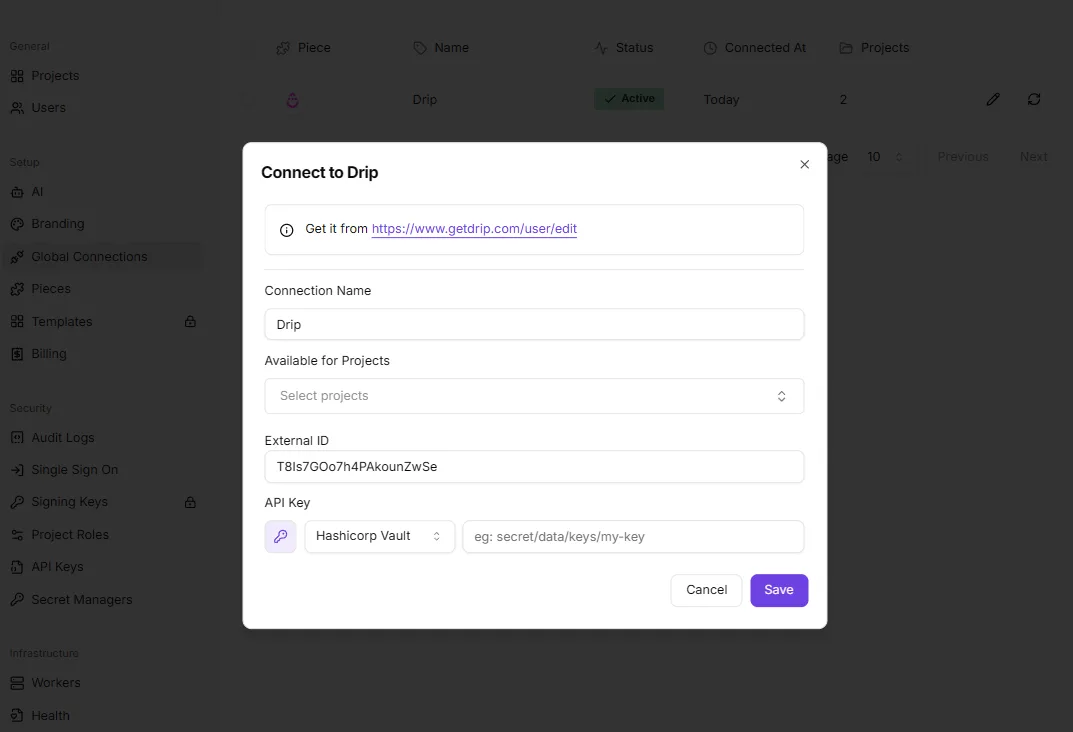
This architecture creates a logical air gap. If Meta AI suggests a status change that violates your business workflow, the middleware catches the error at the integration layer.
Setting hard caps on AI-driven API calls
Activepieces traces every tool call and decision step alongside the deterministic flow, exporting these traces as event streams into the SIEM your security team already uses.
By unifying agent decisions and fixed workflow steps in a single run trace, the platform ensures that an agent's logic is audited with the same visibility as a standard employee action.
When a model like Claude Opus 5.5 is tasked with complex agentic coding or knowledge work, a logic error in the prompt can cause the agent to retry a failing request thousands of times in seconds.
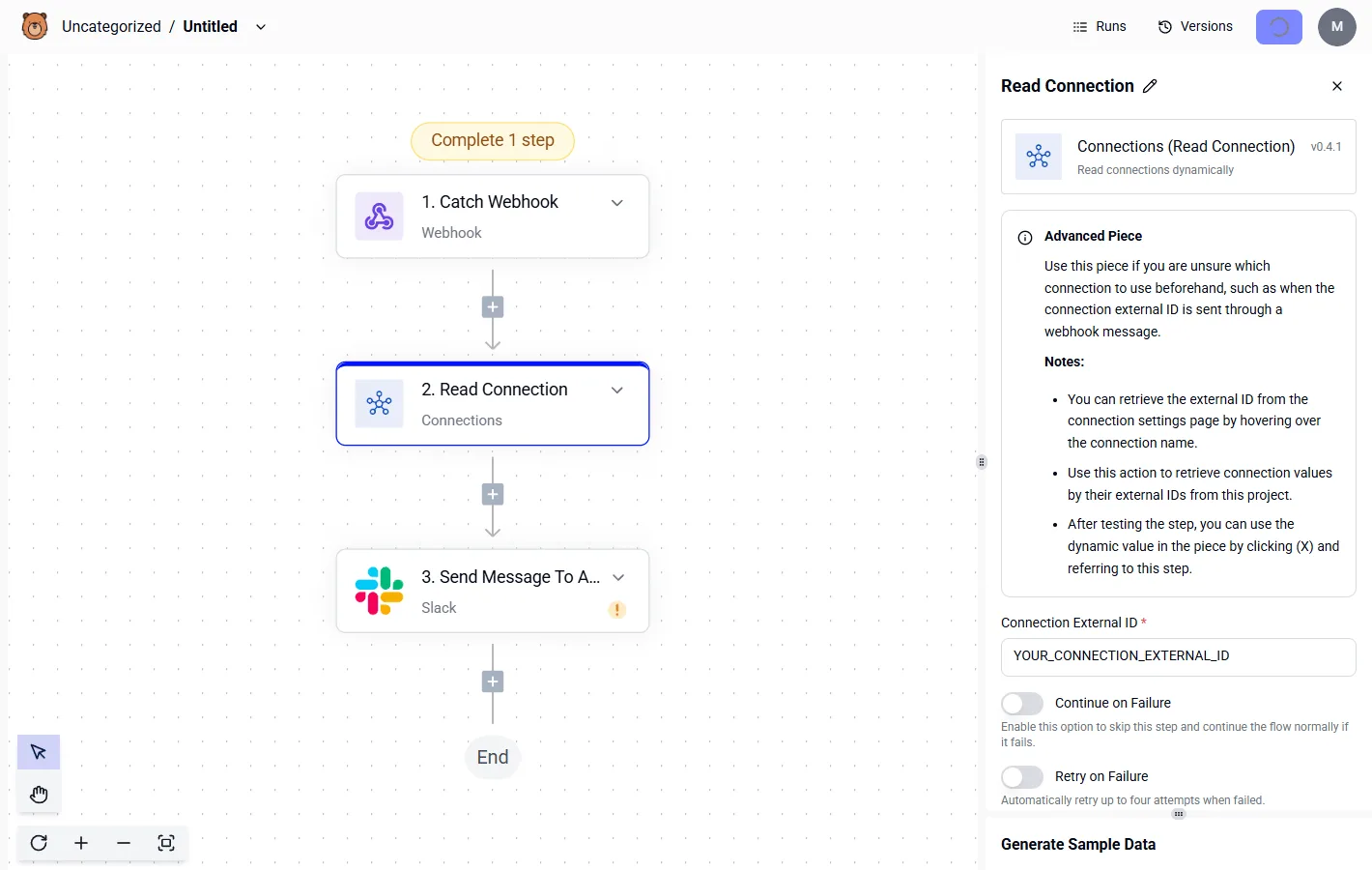
MoneyGram and FundingSocieties run Activepieces in production to manage these environments, ensuring that agent decisions are reviewed with the same rigor as deterministic workflow steps.
This prevents a minor script error from resulting in a total service lockout for the rest of your organization.
Auditing every prompt and response in one dashboard
Centralizing all Meta AI traffic through Activepieces provides a forensic log of the exact context sent to the model and the raw JSON returned. This is necessary for identifying the root cause of silent failures.
The Activepieces dashboard exposes the full execution history for every run. You can see if a failure was caused by a malformed prompt, a timeout in the model’s response, or a change in the underlying data structure.
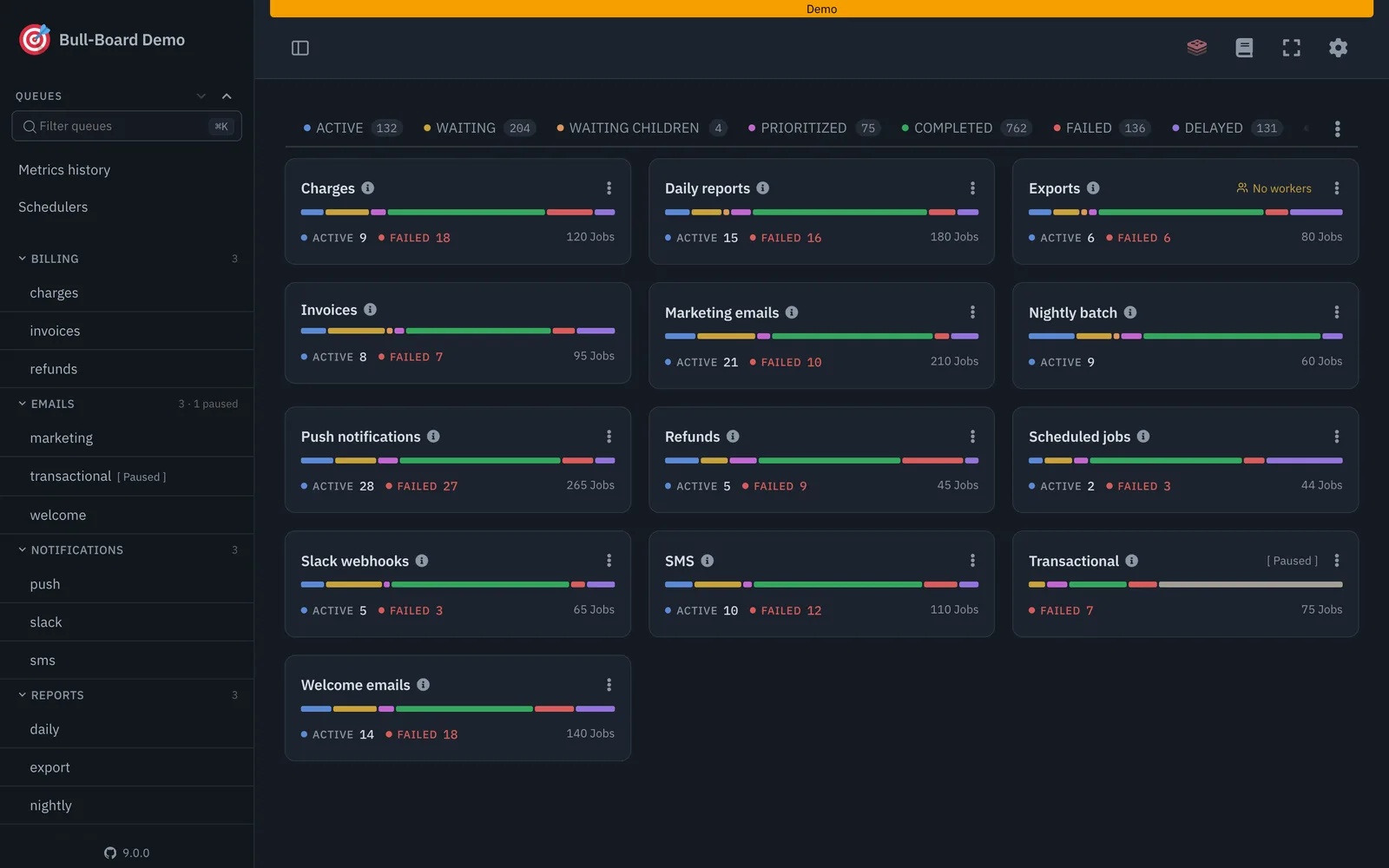
This visibility turns a vague troubleshooting ticket into a specific fix, as every automated action is tied to a visible, time-stamped log entry.
Monday morning Meta AI safety checklist
Operational stability requires treating every Meta AI integration as a privileged user whose permissions must be explicitly validated rather than assumed.
Without a middleware layer to intercept and verify calls, a rogue recursive loop or an unhandled exception in a tool-use chain can escalate into a full-scale data corruption event.
Audit all active Meta developer tokens
Every credential used by the WhatsApp Business API must be mapped to a specific service account with limited scopes during a comprehensive audit.
- Verify that tokens are restricted to the minimum required permissions, such as
messages_sendwithoutaccount_management, to prevent an agent from modifying its own administrative settings. - Check the IP allowlist in the Meta Developer Console to ensure that only authorized middleware servers can initiate requests, which blocks unauthorized traffic even if a token is leaked.
- Review the "App Dashboard" for any third-party apps with "Advanced Access" that are no longer in active use so that the attack surface remains as small as possible.

Implement a secondary approval layer for data writes
A secondary approval layer acts as a physical circuit breaker between the AI model and your system of record, such as Salesforce.
By requiring a deterministic check before any POST or DELETE command is executed, you prevent a reasoning error in a model like Claude Opus 5.5 from accidentally wiping a lead database during a misunderstood support interaction.
Set up external monitoring for API latency spikes
Monitoring for latency spikes provides an early warning system for "hallucination loops" where an agent repeatedly calls an endpoint with invalid parameters.
When a middleware layer detects that response times from the Meta Graph API (the primary data gateway for Meta services) have deviated from the baseline, it should automatically throttle the agent's identity to prevent a total exhaustion of your API rate limits.
The following checklist provides the immediate steps for your operations team to secure the environment:
- Review the Meta Business Manager privacy settings and Llama provider terms to confirm that data sharing for model training is disabled at the organizational level.
- Rotate all WhatsApp Business API tokens to ensure that no legacy credentials remain active in unmonitored scripts.
- Insert a 5-second delay step in all recursive loops to prevent rapid-fire API calls from triggering a platform-wide ban.
- Enable PII masking in the middleware layer to ensure that sensitive customer data never reaches the model's inference logs.
Frequently asked questions about Meta AI safety
Does Meta AI use my business data to train its models?
Meta AI integrations typically operate under a shared-responsibility model. Data sent to the inference endpoint is excluded from foundational training, but metadata and interaction logs are often retained for service improvement.
Without a middleware layer to strip identifying information, your internal schema names and proprietary prompts become part of the provider's telemetry.
This means a competitor’s prompt engineering could theoretically be influenced by the architectural patterns leaked in your logs.
Can I limit Meta AI to read-only access for my CRM?
Native integrations usually lack the ability to distinguish between "viewing a record" and "updating a status." They often inherit the broad OAuth scopes granted to the connecting user.
Implementing a middleware identity for the agent allows you to apply specific Role-Based Access Control (RBAC) that restricts the agent to GET requests.
This ensures a hallucinating model can't accidentally trigger a mass deletion in a customer relationship management platform like Salesforce.
What is the difference between a native Meta integration and an iPaaS?
A native integration connects the model directly to an application’s API via a pre-built plugin. An Integration Platform as a Service (iPaaS) acts as a programmable buffer between the two. The primary differences involve control and visibility:
- Native integrations provide a "black box" connection where the model dictates the logic, so you can't intercept or modify a request before it hits your database.
- An iPaaS allows for the insertion of logic gates and data masking, so sensitive fields like social security numbers are redacted before they reach the model.
- Middleware supports rate limiting at the identity level, so a runaway agentic loop in a reasoning model like Gemini 2.5 Flash can't exhaust your API quotas in a single afternoon.