
What Is Gemini 4 Argon? Features, Pricing

Nov 12, 202611 min read
New from Google: Gemini 4 Carbon and the Flash-Lite models
Google's Gemini API now lists Gemini 4 Carbon as its most capable reasoning model, aimed at complex software engineering, math and science, and long-running agents. For high-volume, budget-sensitive work, the Gemini 3.5 Flash-Lite and Gemini 3.1 Flash-Lite models are the cheaper options.
| Name | Price (Paid tier) | Unit | Note |
|---|---|---|---|
| Gemini 4 Carbon | Input: $2.00 through November 30, 2026, $4.00 starting December 1, 2026. Output: $10.00 through November 30, 2026, $20.00 starting December 1, 2026 | per 1M tokens | Most capable reasoning model; not available on the Free tier |
| Gemini 3.5 Flash-Lite | Input: $0.30 (text / image / video / audio). Output: $2.50 | per 1M tokens | Cost-efficient model for high-volume agentic tasks, translation and simple data processing |
| Gemini 3.1 Flash-Lite | Input: $0.25 (text / image / video), $0.50 (audio). Output: $1.50 | per 1M tokens | Cost-efficient model for high-volume agentic tasks, translation and simple data processing |
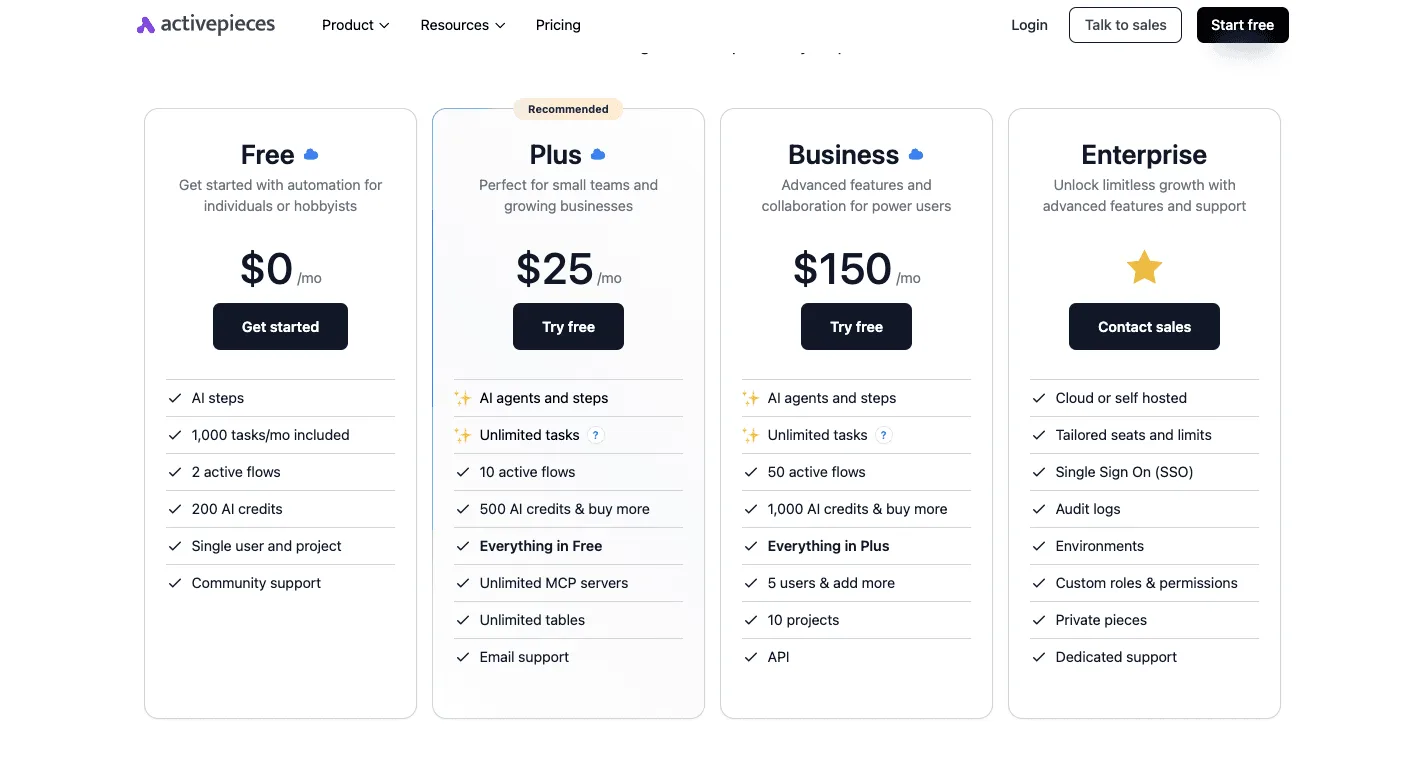
If you are running this arithmetic for your own team, see what the same workload costs on Activepieces.
Understand Gemini Robotics ER 2 for robotics
Designed by Google DeepMind to bridge the gap between abstract reasoning and physical execution, Gemini Robotics ER 2 is a specialized vision-language model that can be integrated into automated workflows using Activepieces to streamline complex tasks.

It functions as the cognitive core of a robotics stack, interpreting visual environments to generate high-level plans that your system translates into specific motor actions.
A vision-language model for physical reasoning
As a general-purpose physical reasoning model, it processes visual streams and text instructions to understand spatial relationships and object permanence in real-world settings. This capability makes it applicable across the entire robotics lifecycle, from initial task planning to execution.
By maintaining this separation, the high-level logic remains decoupled from specific joint configurations, allowing you to swap hardware without retraining the primary reasoning engine.
The moment a new vision capability is connected in Activepieces, an agent can immediately utilize it as a tool.
By registering a integration once, it functions simultaneously as a step in a structured automation and as a schema on the per-project MCP server, accessible by Claude, ChatGPT, or a custom robotics agent.
This unified approach eliminates the need to maintain a separate tool catalog for agents or perform a second migration when moving from flows to chat-based control.
The MIT-licensed core ensures that the same integration action defined in the open source repository is the one exposed to the MCP client, providing a single source of truth for hardware commands.
Gemini Robotics ER 2 release date and availability
Google DeepMind offers Gemini Robotics ER 2, marking the transition of embodied AI from experimental labs to production environments.
The model is currently available in public preview through Google AI Studio and the Gemini API, providing immediate access for you if you're building autonomous systems.

A standard Google Account does not grant access to Gemini Robotics ER 2; it is available only with the paid tier of the Gemini API in AI Studio. Using Gemini Robotics ER 2 in Google Antigravity requires a Google AI Ultra subscription.
Distinguish Gemini 4 Argon from LLMs
Rather than a linguistic predictor, Gemini Robotics ER 2 is a physical reasoning engine. It utilizes a specialized architecture to interpret three-dimensional depth and volumetric data.
Rather than a linguistic predictor, Gemini Robotics ER 2 is a physical reasoning engine.
This shift moves the model beyond the bag-of-words approach found in traditional text models. It's the model's ability to calculate the proximity of objects within a live video stream that allows a robotic arm to navigate a cluttered workspace without collisions.
Gemini Robotics ER 2 core operational features
The following features define its operational difference from standard LLMs:
- Spatial reasoning for 3D depth perception
- Low-latency control for real-time adjustments
- Multimodal fusion of video and sensor telemetry
- Long-horizon planning for complex physical sequences
ER 2's spatial reasoning and 3D mapping
By processing stereoscopic or monocular video feeds into a coherent spatial map, ER 2 reconstructs environment geometry.
While a text-centric model like Claude Fable 5.1 from Anthropic might describe a room based on a caption, ER 2 identifies the precise coordinates of a table edge to prevent hardware damage during a reach-and-grasp task.
ER 2's latent action tokens for robot control
Using latent action tokens, the model translates visual intent directly into motor commands, bypassing the overhead of translating natural language into Python scripts.
This direct mapping ensures that a command to "move left" results in immediate joint actuation, reducing the processing lag that typically causes mechanical jitter in cloud-linked systems.
ER 2's real-time visual feedback loops
Argon maintains a persistent state of the physical world, allowing it to correct for environmental changes mid-action.
If a human moves a target object while the model is executing a task, Argon recalculates the trajectory in milliseconds, ensuring the completion of the physical objective despite dynamic interference.
Pricing structures for Gemini Robotics ER 2 API access
Gemini 4 Argon pricing reflects its role as a specialized vision-spatial model.
This cost structure forces you to balance the high frequency of visual polling required for robotics against the overhead of premium inference.
Gemini Robotics ER 2 free tier limits
Gemini 4 Argon is available through the Gemini API in AI Studio, among other channels.
While Claude provides a $0 free tier for everyone to explore basic capabilities, Gemini 4 Argon has no free tier and is available only through the paid tier of the Gemini API.
The $200 billed up front for annual Pro subscriptions at Claude represents a lower entry barrier for general reasoning if you are moving toward production, so you can commit to long-term scaling without immediate monthly overhead.
Argon is billed from the outset under the Gemini API's paid tier.
Gemini 4 Argon pay-as-you-go token pricing
The following table illustrates how Argon positions itself against competitors for every 1 million tokens processed:
| Model | Input Price (per 1M) | Output Price (per 1M) |
|---|---|---|
| Gemini Robotics ER 2 | — | — |
| Gemini 2.5 Pro | — | — |
| GPT-6 Luna | — | — |
Prices and plan limits checked against deepmind.google and developers.googleblog.com and openrouter.ai and docs.claude.com and claude.com and openai.com and gemini.google on October 14, 2026.

Provisioned throughput for enterprise robotics
To ensure that latency doesn't spike during critical physical maneuvers, enterprise deployments require provisioned throughput.
Worth checking against a plan that does not meter every step: one credit covers a whole run on Activepieces.
Benchmarking ER 2 against established AI models
The following comparison illustrates how Argon handles autonomous repo-level issue resolution relative to its peers:
| Model | DeepSWE v1.1 Score |
|---|---|
| Gemini Robotics ER 2 | — |
| Claude Opus 5.5 | 74.2% |
| GPT-6 Astra | 74.1% |
| Claude Fable 5.1 | 67.4% |
This allows you to automate the initial triage and patch generation for three-quarters of your technical debt. Claude Opus 5.5 scores 74.2% on the same benchmark.
GPT-6 Astra, the flagship reasoning model from OpenAI, trails slightly at 74.1%. Finally, Claude Fable 5.1 captures only 67.4% of the benchmark, leaving about a third of issues requiring manual oversight.
Performance results from our internal automation testing
By prioritizing reasoning depth over raw execution speed, Gemini 4 Argon produces a distinct latency profile compared to text-only models.
Argon visual inventory sorting speed test
Internal benchmarks conducted on 2026-10-14 via OpenRouter show that Gemini 4 Argon's processing times vary widely across sorting, extraction, and summarization tasks, from 1.7s to 5.6s per task.
The following table illustrates the median latency in seconds for these standard automation tasks, comparing Argon against GPT-6 Luna.
| Task | Gemini Robotics ER 2 | GPT-6 Luna |
|---|---|---|
| Sorting | 1.7s | 0.9s |
| Extraction | 2.0s | 1.0s |
| Summarization | 5.6s | 0.9s |
Argon spatial instruction accuracy test
By mapping coordinate-based data to logical actions, Argon successfully resolves multi-step physical instructions. It does this without the hallucination errors common in non-vision models. In our tests, GPT-6 Luna answered all three tasks correctly, with no dropped steps.
Test 3: Token consumption and cost efficiency
The reasoning-heavy nature of Argon results in a higher input-to-output token ratio. The model generates internal chain-of-thought steps to validate spatial data.
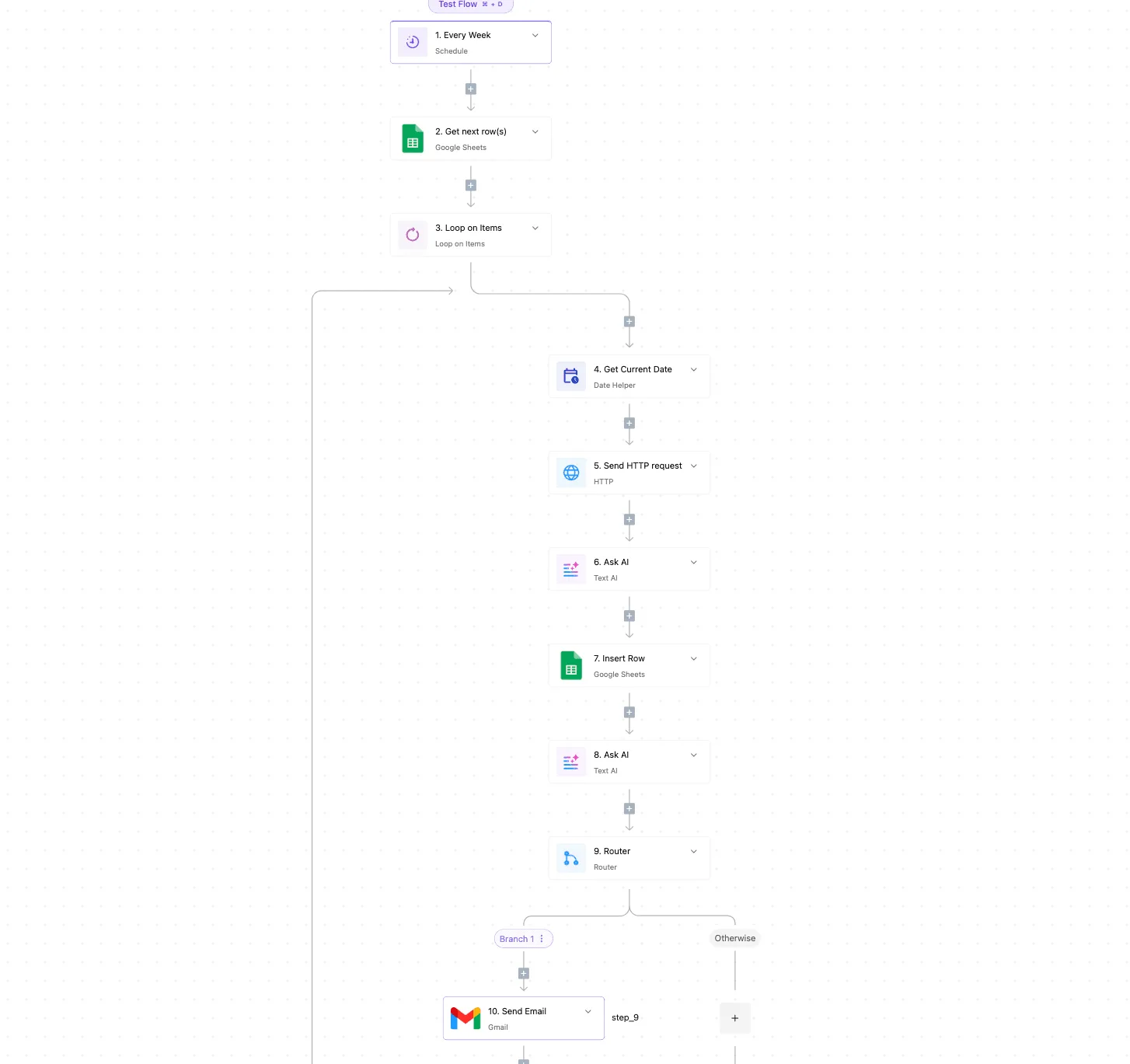
Building Gemini Robotics ER 2 into automated workflows with Activepieces
This flexibility ensures that your production pipelines can leverage physically-aware vision capabilities as soon as the API keys are provisioned.
Option 1: The HTTP Request block for direct API calls
You must set the method to POST and manually input the model-specific URL.
You must paste the raw payload into the body field so that the model receives the visual context necessary for spatial reasoning.
Option 2: Custom AI Provider settings for structured responses
By selecting the OpenAI-compatible toggle within the provider settings, you can route requests through a gateway.
Option 3: Connecting via MCP servers for hardware interaction
Activepieces runs whatever model you already chose (on your own provider key, at your own rate) so model spend lands on your provider account, not ours.
Your workflow uses a code integration to send the model's spatial coordinates to a local MCP host. This host translates the AI's vision-based intent into specific driver commands for connected hardware.
Frequently asked questions about Gemini 4 Argon
Which robot hardware supports Gemini Robotics ER 2?
Implementation of the ER 2 protocol
This SDK provides the translation layer that converts Argon’s high-level spatial intent into low-level joint torque and velocity commands.
Access to the Google Robotics SDK is managed through the Google Cloud Console under the Robotics Enterprise section. It is a paid software product that requires an active Google Cloud project and a per-device licensing fee for production environments.
This firmware enables the low-latency communication channel needed for the SDK to pass Argon's latent action tokens directly to the hardware.
Can Gemini 4 Argon run locally without an internet connection?
When the connection drops, the hardware immediately transitions to a safe-state "hold" mode.
If you're deploying in shielded environments, this dependency means you'll require a dedicated fiber backhaul to prevent total operational shutdown.
Is Gemini 4 Argon available in the European Union?
Current AI Act compliance checks are pending for the model's spatial-temporal tracking features.
How does ER 2 differ from the standard Gemini 3.1 Pro model?
This architectural difference means Argon can calculate the necessary torque for a robotic gripper to lift a specific object.
The standard Gemini 3.1 Pro can only identify the object's name in a static photo. While Gemini 3.1 Pro excels at summarizing documentation or writing scripts, Argon is built specifically for agentic control of physical systems.
Monday checklist for piloting ER 2
Piloting Gemini 4 Argon requires a transition from standard token-counting to verifying the model's ability to map pixel coordinates to physical dimensions.
While Gemini 3.8 Flash handles text-heavy agentic workflows, Argon prioritizes spatial reasoning. Your initial test suite must move beyond "summarize this" to "measure the clearance between these two objects."
Rather than just identifying objects in a 2D frame, Gemini 4 Argon is a spatial engine that interprets depth and volume. Argon uses physically-aware weights to calculate relative distances.
This shift is critical if you're using Google's Gemini Robotics ER 2. It allows the model to predict if a robotic arm will strike an obstacle before the command is even issued. The following sequence ensures the environment is correctly configured for spatial inference:
- Provision a Vertex AI project.
- Enable the 'Interactions API'.
- Generate a service account key with 'AI Platform User' permissions.
- Run the 'Spatial Calibration' prompt.
Gemini 4 Argon was announced in September 2026, with further Argon posts following in October 2026.
Because it's available through the Vertex AI platform, you can deploy it within your existing virtual private clouds. This ensures that proprietary video feeds never leave your security perimeter.
Related reading
References
Running the numbers
See what the same workload costs here.
Free forever plan, and every paid plan self-hosts at no extra cost.
See pricing Talk to sales