
What Is MiMo V2.6 and How It Performs in 2026

Oct 16, 202614 min read
MiMo V2.6 is an open-weights model series from Xiaomi MiMo covering coding, general-purpose agent tasks, visual coding, and cybersecurity.
As organizations look to streamline their digital workflows, many are integrating these capabilities with automation tools like Activepieces to ensure seamless connectivity across disparate cloud environments.
MiMo V2.6 is an open-weights reasoning model architecture designed to deliver high-efficiency cognitive performance while utilizing a fragmented infrastructure framework.
Xiaomi mimo v2.6 reasoning-focused model series
Xiaomi released a family of reasoning-focused large language models with open weights. This launch introduced a series of checkpoints designed to maximize logic throughput and provide a local alternative to proprietary models.
Everything below works on Activepieces' free plan. Start without code or a credit card.
Accessing mimo v2.6 and hosting costs
Because MiMo V2.6 is distributed as an open-weights collection rather than a managed service, users must secure their own compute or use a third-party aggregator. Xiaomi offers the models through its Xiaomi MiMo Open Platform API, and they are also available on OpenRouter.
The cost of intelligence is shifted from per-token billing to the fixed overhead of hardware maintenance or the fluctuating margins of inference providers.
Where to download the model weights
By hosting the model weights on Hugging Face, the central repository for open-source machine learning, Xiaomi allows developers to integrate them into private pipelines without a recurring licensing fee.
The cost of intelligence is shifted from per-token billing to the fixed overhead of hardware maintenance or the fluctuating margins of inference providers.
Accessing the repository requires a registered account to accept the Xiaomi Community License. This step ensures the user is legally compliant with their specific usage restrictions before the download starts.
Self-hosting vs. third-party inference providers
To ensure total data sovereignty and predictable long-term costs, organizations can turn to self-hosting. It allows an organization to run continuous batch processing without hitting the rate limits common in shared environments.
Conversely, using third-party providers like Together AI or DeepInfra is a method for immediate scaling. This approach allows a team to prototype a reasoning agent without the upfront capital expenditure of purchasing server racks.
Hardware requirements for the 9B and 30B versions
Depending on the desired precision and the specific parameter count of the chosen model version, the hardware footprint for MiMo V2.6 varies.
This pushes larger deployments toward dedicated accelerators, though quantization keeps smaller setups viable.
Quantized versions of both models reduce the memory requirement at the cost of slight reasoning degradation. Teams with limited budgets may find the larger models hard to deploy without multi-GPU hardware.
Hardware requirements for mimo v2.6 deployment
Deploying MiMo V2.6 locally demands a steep hardware investment that scales aggressively with model intelligence. While the distilled versions fit on consumer hardware, the flagship tiers require enterprise-grade clusters that shift the cost burden from operational expenditure to significant capital investment.
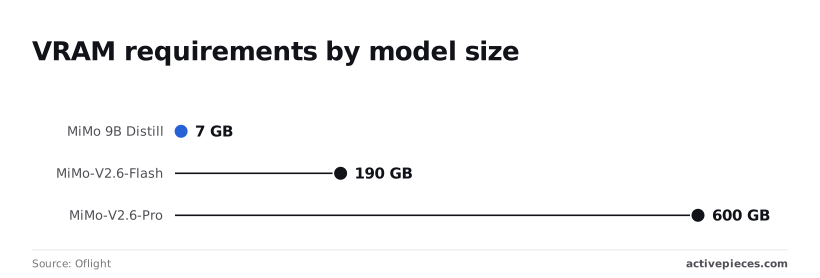
Vram requirements by model size
Dictating whether a project runs on a single workstation or a server rack, the VRAM needed to load MiMo V2.6 depends entirely on the chosen parameter count and precision.
MiMo 9B Distill can run locally on a standard NVIDIA RTX 4060 for basic reasoning tasks, according to Oflight.
MiMo-V2.6-Flash is a large mixture-of-experts model that requires substantial GPU memory to initialize. MiMo-V2.6-Pro demands a large HGX cluster to avoid out-of-memory errors during inference.
Choosing gpus for local inference
Balancing precision against the physical footprint of the server is required when selecting hardware for the Pro-RL variant. The MiMo-V2.6-Pro-RL model at FP16 precision requires substantial VRAM, so only massive multi-node clusters can run the model without quantization.
Moving to INT8 reduces the VRAM requirement, allowing the model to fit on smaller hardware configurations.

This reduces the necessary infrastructure footprint compared to running the model at full precision.
For teams constrained by rack space, INT4 quantization brings the VRAM requirement down further. This allows the model to fit on a single eight-way GPU system, so deployment is possible in far more limited physical environments.
Scaling infrastructure for the 600gb pro model
Deploying the Pro model locally remains out of reach for typical desktop hardware even with INT8.
The VRAM floor is high enough that an organization must commit to a multi-GPU cluster connected via a high-speed interconnect such as NVLink to prevent communication overhead from stalling the model's reasoning speed.
This infrastructure requirement means the transition from MiMo-V2.6-Flash to Pro represents a substantial increase in hardware density.
Furthermore, this forces a move from standard server rooms to specialized high-density data centers, as existing cooling and power capacities will no longer suffice.
Mimo v2.6 performance compared to established LLMs
By scaling reinforcement learning (RL) for self-improvement, MiMo-V2.6-Pro-RL keeps expanding its capability frontier through exploration and feedback.
The Xiaomi MiMo Team designed this flagship checkpoint to maximize logic throughput per parameter, though the resulting infrastructure requirements complicate the cost-to-performance ratio for mid-sized deployments.
Distill-qwen-9b vs. GPT-6 Luna logic tasks
While GPT-6 Luna benefits from the unified ecosystem of OpenAI, the 9B model is capable of local execution.
GPT-4o-mini, a deprecated model, cost $0.15 per 1M input tokens according to Computeprices.
Claude Haiku 4.5 was priced at $1 per 1M input tokens and $5 per 1M output tokens, well below the larger Claude tiers; the current fast tier is Claude Haiku 5.5. MiMo sits in an uncomfortable middle ground.
Self-hosting adds infrastructure costs.
Pro-RL 1.02T vs. DeepSeek-V4-Pro reasoning chains
To handle multi-step reasoning chains that typically require the parameter counts found in models like DeepSeek-V4-Pro, the 1.02T-parameter (42B activated) Pro-RL model leverages reinforcement learning.
By optimizing for self-correction during inference, the Pro-RL variant maintains logical consistency across longer prompts as the flagship Sparse MoE checkpoint of the series.
This efficiency helps developers deploy agentic workflows, though the Pro model still needs a large GPU cluster. They lose the managed scaling and pre-integrated safety layers provided by the DeepSeek-V4-Pro-0813 API.
Flash-rl latency for real-time applications
In agentic workflows where GPT-6 Luna or Gemini 3.1 Flash-Lite would typically be the default choices, Flash-RL is an available alternative. By stripping away non-essential weights while retaining RL-tuned logic paths, the model reduces the time to first token for interactive systems.
The lack of a managed global endpoint means users must architect their own load balancing to match the 99th-percentile reliability of a provider like Anthropic or Google.
Testing MiMo v2.6 on common automation tasks
In structured automation, MiMo V2.6 Distill-Qwen-9B is a 9B agentic model designed for coding, general-purpose agent tasks, visual coding, and cybersecurity.
Our internal benchmark ran on 2026-09-29 compared the Xiaomi MiMo-V2.6-Pro via OpenRouter against OpenAI’s GPT-5.4-mini across three core enterprise workflows, providing a snapshot of how these architectures perform under identical real-world conditions, so any subsequent updates to these models could render these specific comparative insights obsolete.
The following table demonstrates that while the open-weights model requires more time to compute its reasoning steps, the financial savings per task are modest compared with managed commodity models, even for developers managing their own infrastructure.
| Metric | MiMo-V2.6-Pro | GPT-5.4-mini |
|---|---|---|
| Success Rate | 3/3 | 3/3 |
| Median Latency | 3.5s | 0.7s |
| Cost per Task | $0.000214 | $0.000144 |
Checked against huggingface.co and huggingface.co and huggingface.co and openrouter.ai.
Enterprise workflow benchmarks
To ensure that downstream database schemas receive clean, validated inputs without manual cleaning, the model successfully pulled specific fields from an invoice.
According to Xiaomi, the architecture is designed for general-purpose agent tasks. This allowed it to ignore formatting noise that often breaks simpler regex-based extractors.
By sorting support tickets into priority tiers, the model demonstrated the logical depth necessary to replace human triage in high-volume queues.
This capability stems from its role as a starting point for open research in agentic reinforcement learning. Xiaomi MiMo evaluates the intent of a query rather than just matching keywords.
When summarizing an email thread into a concise update, the model maintained brand tone while adhering to strict length constraints. This ensures that automated summaries provided to stakeholders remain professional and readable.
It avoids the repetitive hallucinated pleasantries common in less sophisticated models.
Easier to see it running than to read about it: set it up free, no card.
Connecting mimo v2.6 to business workflows
Because the framework lacks the one-click native integrations found in proprietary ecosystems, connecting MiMo V2.6 to existing software requires manual bridging. By treating MiMo as a raw inference engine, developers can pipe its reasoning capabilities into enterprise tools through standardized communication protocols.
Using OpenAI-compatible API wrappers
When fronted by an OpenAI-compatible translation layer, MiMo V2.6 functions as a drop-in replacement for proprietary endpoints. This setup allows teams to swap calls to GPT-6 Luna for local MiMo inference without rewriting the core application logic.
LiteLLM is a library that standardizes LLM API calls. By utilizing this wrapper, an engineer can point an existing agentic workflow at a MiMo instance by simply changing the base URL.

Comparing the enterprise feature list (SSO, SCIM, custom RBAC, audit logs, release management, and secret managers) in the self-hosted air-gapped docs against the managed cloud shows the same list either way.
Activepieces does not sell a smaller product to the buyers who need the most control, ensuring that regulated organizations can bridge local MiMo reasoning to their SaaS stack with the same governance tools found in the managed cloud.
Connecting via generic HTTP request steps
For low-code platforms that lack a dedicated MiMo block, the generic HTTP request remains the most reliable method for data exchange. Users must manually configure the headers and body to match the MiMo V2.6 inference specification.
This requires more upfront effort than a managed connector but prevents vendor lock-in. Activepieces runs the MiMo model you already chose on your own provider key, so execution spend lands on your own account rather than being resold at a markup.
When a workflow in a tool like Zapier sends a POST request to a self-hosted MiMo endpoint, the system gains the ability to process sensitive internal documents without passing them through a third-party cloud provider.
Deploying through an MCP server for local tools
To allow MiMo V2.6 to interact with local files and databases through a standardized interface, the Model Context Protocol (MCP) provides a structured way forward.
Implementing an MCP server allows the model to act as an agent that can read and write to a local PostgreSQL database or a specific GitHub repository.
This architectural choice turns MiMo from a passive text generator into an active tool user. A developer can automate repetitive tasks like schema migrations or documentation updates directly within their local IDE environment.
Strengths and limitations of the MiMo v2.6 architecture
MiMo V2.6 is built for high-efficiency reasoning, making it a specialized tool for narrow, high-complexity tasks rather than broad document synthesis.
Reasoning depth vs. context window
Because it allocates more compute to internal chain-of-thought processing, the architecture excels at multi-step logical deduction. This allows it to solve complex engineering problems that often trip up larger, general-purpose models.
This focus on depth is paired with a 1M-token context window. The 1M-token context window lets it hold large codebases or long legal documents without losing coherence.
Developers must therefore implement aggressive retrieval-augmented generation (RAG) strategies to feed the model only the most relevant snippets, adding significant pre-processing complexity to the pipeline.
Multi-lingual performance and management
Because the training data remains heavily skewed toward Western linguistic structures, the model's performance degrades sharply in non-Latin scripts. This occurs even while it is highly proficient in English-based programming logic.

This imbalance results in higher hallucination rates for technical documentation written in languages like Japanese or Arabic. Global teams must maintain separate translation layers or fallback models for international deployments.
Utilizing MiMo V2.6 is a way to gain full control over data privacy and model behavior, eliminating the unpredictable latency and black box updates common in proprietary APIs. The hidden cost lies in the infrastructure burden.
Local hosting requires dedicated GPU clusters, so the initial capital expenditure is significantly higher than a pay-as-you-go subscription. Version control falls entirely on the DevOps team, meaning security patches and performance optimizations must be manually integrated.
Generic API connections often lack the optimization found in native integrations. The engineering team spends more time tuning middleware than building features.
Deployment checklist for mimo v2.6 models
Moving to MiMo V2.6 over a managed service like Gemini 3.8 Flash requires a shift from consuming a utility to maintaining a private infrastructure stack.
While the efficiency gains are tangible, the transition hinges on whether the organization can absorb the operational friction inherent in self-hosting.
Moving to MiMo V2.6 over a managed service like Gemini 3.8 Flash requires a shift from consuming a utility to maintaining a private infrastructure stack.
Assessing internal hardware capacity
Deploying MiMo V2.6 necessitates dedicated GPU clusters with sufficient VRAM to hold the model weights alongside active inference buffers. If the existing server farm lacks high-bandwidth interconnects, the resulting communication bottlenecks could further slow the model’s performance.
Teams must verify that their orchestration layer can handle dynamic scaling. A lack of automated provisioning leads to service outages during unexpected traffic spikes.
Evaluating reasoning requirements
MiMo V2.6 is designed for dense logic tasks such as coding and agentic workflows. Organizations should audit their specific use cases against production readiness criteria to determine if the model fits their operational flow.
These criteria include infrastructure choices between self-hosted and provider models, and a latency tolerance for reasoning times, which defines the boundaries of acceptable performance for the end user, ensuring that system responsiveness remains aligned with operational expectations, so developers must prioritize architectural efficiency to avoid frustrating delays in real-time interactions.
Teams must also consider context requirements and security compliance for air-gapped or public cloud needs. This audit ensures that the model’s architectural constraints align with the actual demands of the end-user.
Planning for API wrapper maintenance
When moving away from standardized endpoints like the GPT-6 Luna API, internal teams are forced to build and support custom middleware.
Because MiMo V2.6 lacks the managed versioning of proprietary models, developers must manually track upstream weight updates and re-validate integration points.
Failure to budget for this ongoing engineering time results in a logic drift. The local deployment then falls behind the performance benchmarks of modern open-weight standards.
Common questions about mimo v2.6 performance?
What is mimo v2.6
MiMo V2.6 is a series of reasoning-focused models released by Xiaomi, designed for high-logic tasks using reinforcement learning and open-weights distribution.
What Activepieces does about this
To solve the governance and security concerns inherent in moving from proprietary clouds to local weights, Activepieces offers a self-hosted, air-gapped edition under the MIT license for its core components.
This ensures that sensitive data processed by MiMo never leaves the organization’s private network, maintaining the data sovereignty that makes open-weights models attractive in the first place.
Organizations like Rakuten use this level of control to automate complex workflows while adhering to strict internal security protocols that public API providers cannot satisfy.
The platform also addresses the maintenance overhead of managing non-standardized endpoints by providing a unified interface for both local and provider-hosted MiMo instances.
This flexibility allows a team to scale their AI operations according to their hardware budget, rather than being locked into a single inference strategy.
Comparing the enterprise feature list (SSO, SCIM, custom RBAC, audit logs, release management, and secret managers) in the self-hosted air-gapped docs against the managed cloud shows the same list either way.
Activepieces does not sell a smaller product to the buyers who need the most control, ensuring that regulated organizations can bridge local MiMo reasoning to their SaaS stack with the same governance tools found in the managed cloud.
This consistency allows developers to focus on tuning the model's reasoning rather than maintaining the plumbing that connects it to the business.