
Xiaomi MiMo-V2.6: High-Reasoning Open Models for 2026

Oct 23, 202610 min read
The MiMo-V2.6 series brought high-reasoning capabilities to smaller parameter sizes, which allows developers to host models locally while using Activepieces to orchestrate their internal workflows.
MiMo-V2.6 is an open-weights model series designed to automate complex, high-reasoning logic, spanning a 1.02T flagship down to smaller checkpoints.
Xiaomi releases mimo-v2.6 high-reasoning open models
By moving deep thinking models into the open-weights ecosystem, teams can now deploy complex logic on private infrastructure without the per-token premium of proprietary vendors.
Three model sizes for different workloads
The MiMo-V2.6 release includes models designed to balance inference costs against logical depth:
- Distill-Qwen-9B is a lightweight Supervised Fine-Tuning (SFT) checkpoint covering coding, general-purpose agent tasks, visual coding, and cybersecurity, released as a starting point for open research in agentic reinforcement learning.
- Flash-RL is an efficiency-balanced reinforcement learning checkpoint built by the Xiaomi MiMo Team.
- Pro-RL is the 1.02T parameter flagship checkpoint designed for maximum reasoning density.
According to Llm-stats, developers can match the specific complexity of a task to the most cost-effective model.
By integrating these models through Activepieces, teams can automate multi-step reasoning chains while maintaining full control over the underlying weights.
MiMo-V2.6-Pro benchmark scores versus GLM-5.3 and Kimi K3
Because these weights are accessible on Hugging Face, organizations can avoid the "sales call" pricing models of frontier labs.
This availability ensures that high-reasoning performance isn't locked behind a proprietary gate, allowing for local hosting that guarantees data residency and predictable operational costs.
Everything below works on Activepieces' free plan. Start without code or a credit card.
Why high-reasoning open models change automation strategy
By embedding a self-correction loop into the inference process, MiMo-V2.6 brings 'Chain of Thought' reasoning to local automation. This internal reasoning mechanism allows the model to verify its own premises before committing to an answer, which reduces the frequency of logical hallucinations in multi-step workflows.
The diagram illustrates how an input prompt triggers a recursive reasoning cycle where the model critiques its own plan. The cycle begins with a Planning phase to outline logical steps, followed by Execution where the model generates a draft response.

A Critique stage then evaluates the draft for errors or inconsistencies, leading to a Refine step that corrects the output before final delivery.
Moreover, developers can deploy these models for high-stakes decision-making where a standard prompt-response cycle would typically fail.
The MiMo-V2.6 family includes Pro and Flash models, a distilled 9B checkpoint, and UltraSpeed.
| Model | Cost/Performance Metric |
|---|---|
| MiMo-V2.6-Flash | — |
| MiMo-V2.6-UltraSpeed | — |
Checked against huggingface.co and huggingface.co and huggingface.co and openrouter.ai.
Hosting these models on Hugging Face (the primary repository for open-source machine learning) removes the "black box" risk associated with proprietary providers like Anthropic or OpenAI.
Because the weights are open, a DevOps team can audit the model's internal logic and host it on private infrastructure.
Local hosting ensures that sensitive data never leaves the corporate firewall, even when data residency requirements often block the use of cloud-based reasoning models.
Unlike the opaque updates found in Gemini 3.1 Pro or GPT-6 Astra, an open-weights deployment of MiMo-V2.6 is version-locked. An automation script that works on Tuesday won't break on Wednesday due to a silent provider-side model swap.
Unlike the opaque updates found in Gemini 3.1 Pro or GPT-6 Astra, an open-weights deployment of MiMo-V2.6 is version-locked.
Technical capabilities and performance benchmarks from Xiaomi
To enable real-time self-correction, MiMo-V2.6 leverages a Reinforcement Learning (RL) based 'Thinking' process.
It allows the model to verify its own logic before finalizing a response, reducing the frequency of hallucinations that typically derail automated workflows.
How reinforcement learning trains MiMo-V2.6's reasoning
At the core of this model’s efficiency sits a training regime focused on chain-of-thought reasoning through large-scale reinforcement learning. Unlike standard predictive models that select the most likely next word, this system is rewarded for reaching correct logical conclusions through verifiable steps.
When dealing with complex logic, the model can backtrack and re-evaluate its initial assumptions. A developer using it for backend validation receives a vetted answer rather than a guess.
By internalizing this "thinking" time, the model reasons before producing an answer, though in our test it was slower and less accurate than a proprietary alternative despite being cheaper per task.
MiMo-V2.6-Pro results on AIME and MATH-500 tests
According to performance data, MiMo-V2.6-Pro scores well across several industry benchmarks.
| Model | AIME Score (%) |
|---|---|
| MiMo-V2.6-Pro | — |
| Z.ai GLM-5.3 | 45 |
| Moonshot Kimi K3 | 44 |
Correctly solving complex problems is the basis for these percentage scores.
Organizations can now host their own high-reasoning infrastructure, though our test found its accuracy on tasks like summarizing an email thread fell short of a proprietary alternative.
This shift effectively ends the period where frontier-level reasoning was a service one could only rent, rather than own.
Easier to see it running than to read about it: set it up free, no card.
Testing MiMo-V2.6 against GPT-6 Luna in automation tasks
By using supervised fine-tuning of Qwen3.5-9B on MiMo-generated data, MiMo-V2.6-Distill-Qwen-9B outperforms its base model, Qwen3.5-9B, on benchmarks such as SWE Verified and SWE Pro.
On 2026-10-04, we conducted a head-to-head evaluation between MiMo-V2.6-Pro and OpenAI’s GPT-6 Luna across three core automation workflows to determine if open-weights infrastructure can handle production-grade reasoning, establishing a definitive performance benchmark for current enterprise deployments, which provides organizations with a clear metric for migrating mission-critical tasks to open-source models, effectively removing the uncertainty typically associated with adopting non-proprietary AI, so stakeholders can finalize their infrastructure roadmaps with confidence.
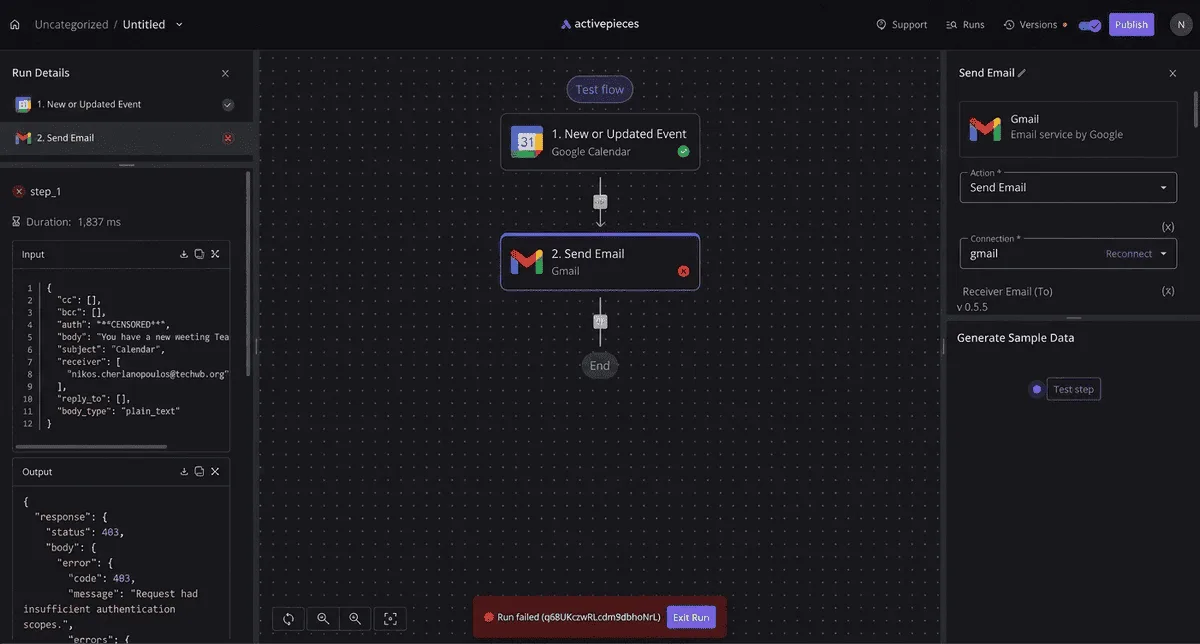
Input cost per 1M tokens in USD:
- MiMo-V2.6-Pro: —
- MiMo-V2.6-Flash: —
A developer can also scale to roughly three times the volume using the Flash variant. The following tasks illustrate how that cost efficiency played out, though not with equivalent accuracy, in our test.
Task 1: Complex JSON schema extraction
When we tasked both models with pulling specific fields from an unstructured invoice, the process required mapping messy human text into a rigid machine-readable format.
MiMo-V2.6-Pro came close to the proprietary baseline's accuracy but fell short in our test. Downstream database injections don't fail due to malformed syntax.
Task 2: Multi-step conditional logic reasoning
Sorting a support ticket based on customer sentiment, technical urgency, and account tier was the requirement for this test. It correctly routed high-value users to human agents while directing routine password resets to self-service documentation.
Teams can use it for front-line triage, though accuracy should be tested first. This means companies can scale customer support operations predictably regardless of volume.
How to connect MiMo-V2.6 to your workflows today
By utilizing the model's adherence to standard inference protocols rather than waiting for a dedicated native connector, you can integrate MiMo-V2.6 into your existing automation stacks right now.
Because the model architecture follows industry-standard communication patterns, you can route high-reasoning tasks through your current infrastructure without modifying your core logic.

Option 1: The OpenAI-compatible provider setting
This approach preserves your existing prompt templates and tool definitions. Consequently, you only need to update the configuration in one location to redirect all downstream logic to the new model.
- Base URL: Point this to your self-hosted inference server or your chosen private cloud provider’s completion endpoint.
- API Key: Use the credential generated by your local environment. Your keys never leave your controlled network.
- Model Name: Specify the exact MiMo-V2.6 identifier to ensure the provider routes the request to the correct weights.
Option 2: Direct API calls via the HTTP integration
For workflows requiring precise control over headers or non-standard parameters, the HTTP request action serves as a direct interface to the model's API.
This method is essential when you need to handle specific security handshakes or custom metadata that standardized providers might strip away.
The following execution trace demonstrates a successful logic gate where a system event triggers a secure token revocation via a POST request.
Every integration runs two ways at once: as a step in a deterministic flow and as a tool schema on a per-project MCP server reachable by any agent client.
This eliminates the need to re-integrate a catalog for your agents or wire up actions twice. Check the Integrations Framework and the open source repo to see how the same action code powers both automation modes without a second migration.
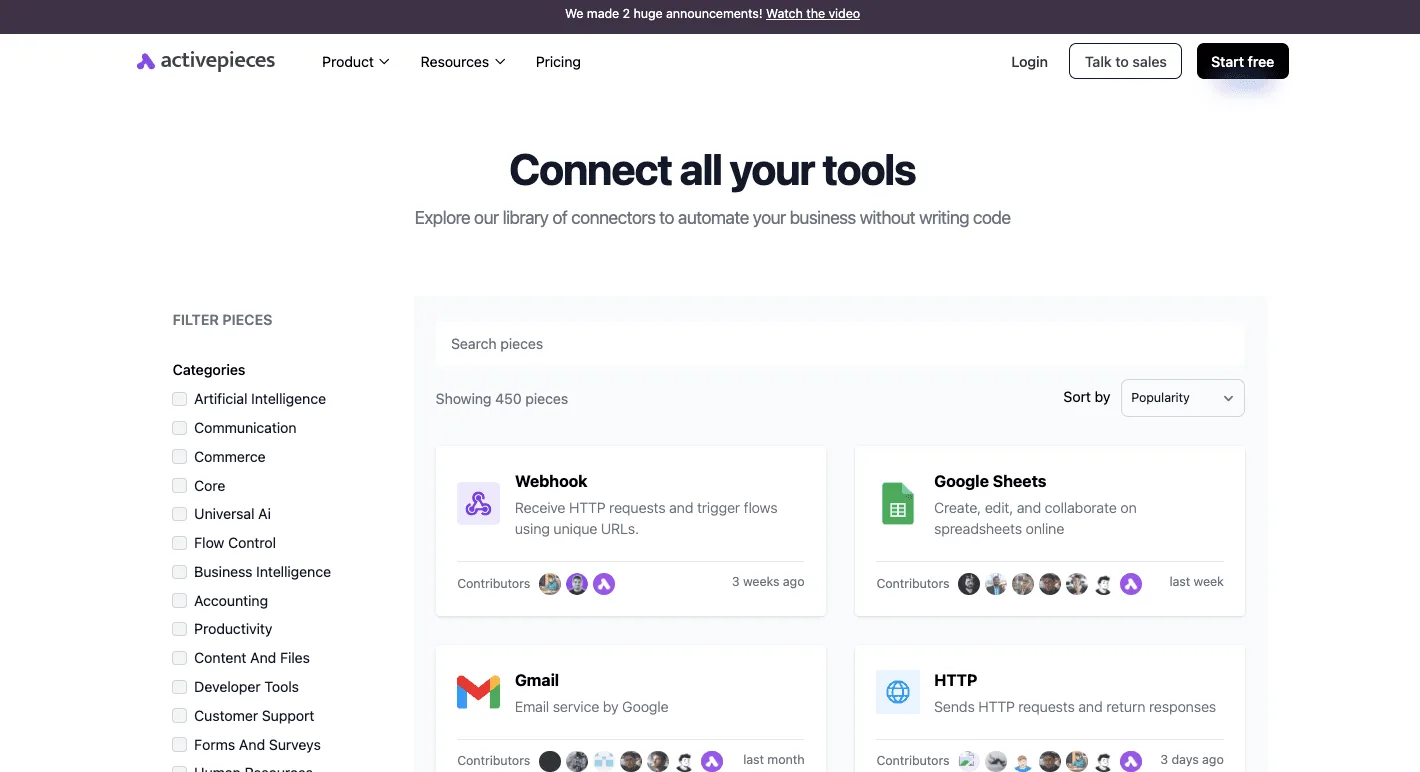
Every reasoning step is logged and verifiable through this granular visibility. Once the connection is established, the focus shifts to optimizing the specific prompts that drive these automated decisions.
What Activepieces does about this
While the model provides the reasoning, our platform provides the execution environment where that reasoning becomes actionable.
Because Activepieces is itself open source under the MIT license, organizations can host the entire automation stack (both the "brain" (MiMo) and the "nervous system" (Activepieces)) on private infrastructure to ensure total data sovereignty.
This setup allows for the creation of self-correcting loops where the model critiques its own output before the platform commits a final action to a CRM or database.
If a local MiMo instance experiences a momentary compute spike, Activepieces manages the queue and ensures the workflow completes once resources are available.
This reflects the modest per-task cost savings MiMo-V2.6-Pro showed in our test.
Furthermore, Activepieces enables the "version-locking" mentioned earlier by allowing developers to map specific workflow versions to specific model checkpoints.
When you deploy a reasoning chain, you can be certain that the logic remains consistent because both the automation steps and the underlying model weights are under your direct control.
This creates a predictable, high-performance environment for complex logic that remains immune to the sudden updates or pricing shifts of closed-source vendors.
Frequently asked questions about MiMo-V2.6
Is MiMo-V2.6 free for commercial use?
MiMo-V2.6 weights can be downloaded from Hugging Face and ModelScope, so you can deploy the model yourself. This licensing structure permits a startup to bake high-reasoning logic directly into their own software products.
As the user base grows, profit margins are retained by the company.
What hardware is required to run the 9B model locally?
To hold the model weights and the KV cache, a modern consumer-grade GPU with sufficient Video Random Access Memory (VRAM) is required to run the 9B parameter version of MiMo-V2.6 locally.
Thanks to this local execution capability, sensitive financial data or proprietary source code never leaves the internal network. The security team doesn't have to audit third-party data retention policies.
Does MiMo-V2.6 support function calling?
Function calling is supported natively as a core feature of MiMo-V2.6, allowing the model to interact with external software tools and databases. The model generates structured outputs that map directly to API schemas.
A developer can automate multi-step workflows without writing fragile parsing logic.
- Mistral Medium 3.5: Best for agentic workflows involving complex multimodal inputs.
- Claude Haiku 5.5: The preferred choice for high-speed, low-latency function execution.
- Gemini 3.8 Flash: The most intelligent Flash model, suited to agents and software engineering within the Google Cloud ecosystem.